PeopleSearchNow is a US people-search site whose free previews of names, ages, addresses and relatives lead into paid background reports at TruthFinder and BeenVerified, and whose removal flow runs in the opposite order from almost every other site we've documented. If you're here because a search for "peoplesearchnow" or "people search now" showed you a page with your own details on it, this article covers what the site is, who owns it, what it actually shows, whether it's legitimate, and how to get your record out, including the 24-hour catch in the removal flow, with every screen in our PeopleSearchNow opt-out guide.
What is PeopleSearchNow?
Peoplesearchnow.com, styled "People Search Now" in its own logo, is a people-search site with three search modes across the top of every page: Name, Phone and Address. Type a name and it promises the usual people-search bundle of age, past and current addresses, phone numbers and relatives, drawn from public records.
Who owns PeopleSearchNow?
The owner isn't named on the site, but it is on file with the state of California. The data broker registry lists PeopleSearchNow.com as one of ten trade names of Mississippi Tornado Alley, LLC of Sacramento, alongside FastPeopleSearch, FastBackgroundCheck, CyberBackgroundChecks, SearchPeopleFree and USPhoneBook. That is the same company a Colorado resident sued in federal court in August 2025 over FastPeopleSearch's publication of mobile numbers (Elliott v. Mississippi Tornado Alley LLC, No. 1:25-cv-02384). Our FastBackgroundCheck profile covers the family in detail.
The site's own pages name nobody; the footer says only "copyright 2004-2026 www.peoplesearchnow.com," so the registry filing is the one place the operator appears. That filing also carries the company's own request numbers for 2024, reported for all ten sites together: 1,204,017 opt-out-of-sale requests received, 993,412 honoured in full and 207,021 denied, about one in six, with a median response time of one day. The company told the state that an opt-out of sale filed on any one of its sites "will apply across all sites." In our own removal work we haven't seen that happen, and the online-collection opt-out is per site by the filing's own admission, so we file on each one.
What we can add from our own probing is how the site makes money. Its results pages lead to paid reports at TruthFinder and BeenVerified, two of the biggest subscription background-check brands. Whether the site is a lightweight partner front-end or a fully separate database with its own records, the thing a visitor experiences is a preview and then a paywall belonging to someone else.
It also sits behind a bot gate that comes and goes. When we first probed it in August 2026, most pages, the homepage included, returned a Cloudflare "verify you are human" check before loading; by early September the homepage and opt-out page loaded without one while the search itself still bounced our tooling. Expect the check, and expect it to move around, which is why we describe what we saw in a normal browser rather than what a script could fetch.
What a People Search Now search shows
The honest answer is that we're not sure it shows anything for free.
Its name search is a form that posts to a /person-search endpoint, and that endpoint sits behind the same Cloudflare human check as everything else. When our engine probed it, we were never able to confirm that it returns a free record card at all. Every path we followed behaved like an affiliate funnel: a teaser about the person, then a button that leaves for a TruthFinder or BeenVerified checkout. In our testing we could not get it to show a free result. That doesn't prove it never does; it does mean that the "people search now" experience for most visitors is a paywall teaser rather than a database you can browse.
Two consequences follow. First, if you found your details through this site, the record you saw most likely lives at TruthFinder or BeenVerified as well, and removing it here does nothing to those. Second, the site's own opt-out form refers to "our data offerings" and "the record you want opted out," so it does maintain records of its own to suppress, whatever the search page shows.
Is PeopleSearchNow legit?
Legit in the sense of real, yes. It's a working site with a working opt-out and a plausible business model. People asking "is peoplesearchnow legit" usually mean one of three things, and the answers differ.
- On scams: it isn't one in the card-skimming sense. There's nothing to buy on the site itself; the purchase happens at the partner brand, under that brand's terms and recurring-billing rules, which are worth reading before you pay.
- On accuracy, treat any preview as an automated guess. Records in this industry are merged by software on name, address and phone, and the familiar errors show up: an old address shown as current, a relative who was actually a former housemate, two half-profiles for one person under a nickname and a legal name.
- On whether it's a search engine or a doorway: in our experience, closer to a doorway. The clearest thing it does for a visitor is warm them up for a paid report elsewhere, and the clearest thing it does for the person being searched is put their name, age and city in front of strangers who can then pay to see the rest.
Is it legal for PeopleSearchNow to publish this?
Under federal law, yes. Sites like this one disclaim consumer reporting agency status, which keeps them outside the Fair Credit Reporting Act. The trade-off works in their favour: the data can't lawfully be used for hiring, tenant screening, credit or insurance decisions, and in exchange the site owes you no accuracy standard and no dispute process. If a listing is wrong, your only remedy is the opt-out.
State law is where change is arriving. California's Delete Act created a deletion platform, DROP, and several other states now require data brokers to register. None yet obliges a site to remove you unprompted, so filing the request remains your job.
What being listed on PeopleSearchNow means for you
The pieces a preview exposes, a name, an age, a city and a relatives list, are exactly the pieces someone needs to confirm they've found the right person before they pay for the rest. That's the funnel's purpose, and it's also the starting kit for doxxing and for the "grandparent" phone scams that need a relative's real name.
The other cost is the one people notice least: the site links your identity to two paid reports elsewhere. A stranger who arrives here can leave with a full report from TruthFinder or BeenVerified in a few clicks, so this site is worth treating as a pointer to those two as much as a listing in itself.
How to remove yourself from PeopleSearchNow
Removal is free, needs no account and no ID upload, and takes about ten minutes plus a wait for an email. What makes it unusual is the order of operations.
| Most people-search sites | People Search Now |
|---|---|
| Find your record, then request removal | Give your name and email first; you haven't seen the record yet |
| Removal form on the site | The real removal form arrives as an emailed link |
| Confirmation email is a receipt | The emailed link expires after 24 hours; miss it and you start over |
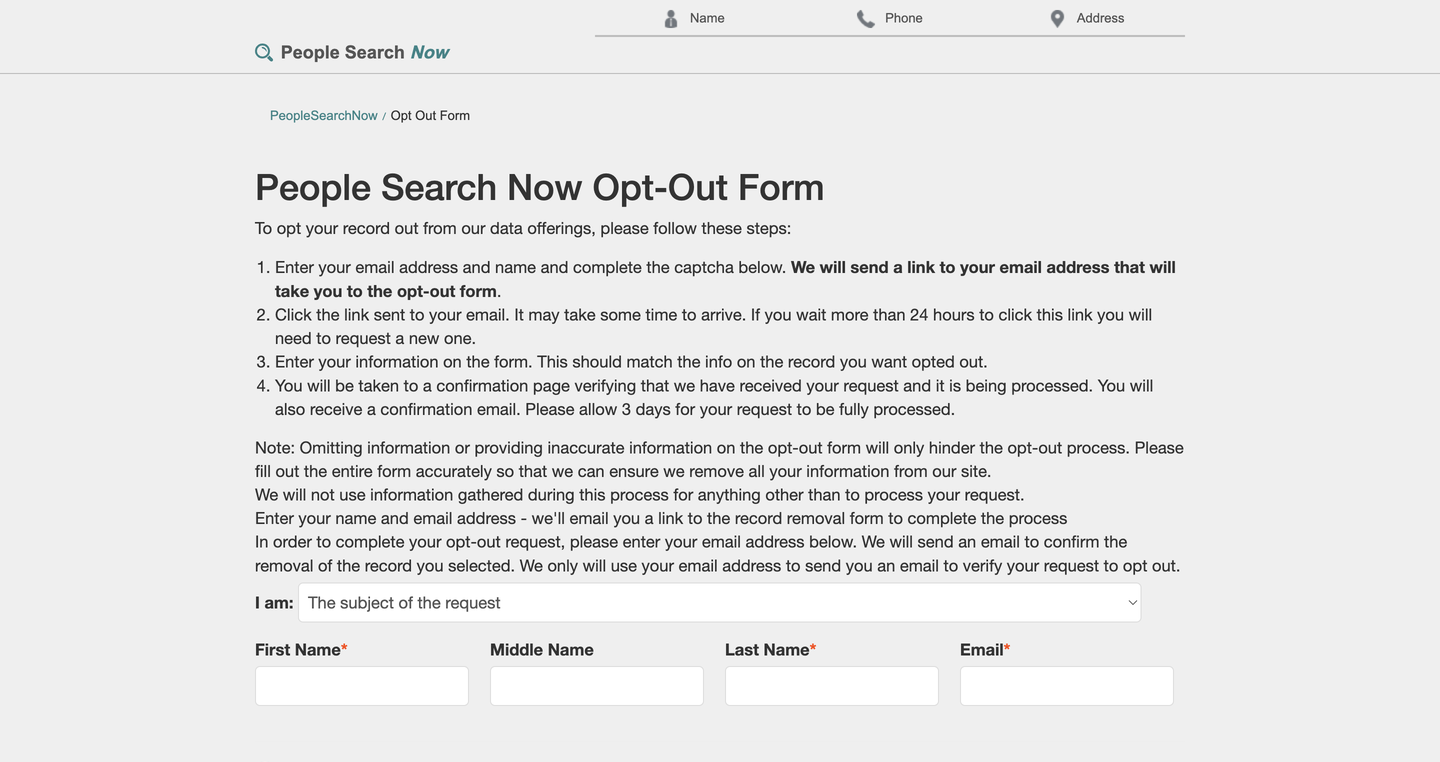
The page above is our own capture of peoplesearchnow.com/opt-out. It's headed "People Search Now Opt-Out Form" and prints its own four steps: enter your email and name and complete the captcha; click the emailed link, which "may take some time to arrive" and which you must use within 24 hours; fill in the form so it matches the record; then land on a confirmation page and "allow 3 days for your request to be fully processed." The form's "I am" dropdown defaults to "The subject of the request," with an option for filing on someone else's behalf, and the fields are first name, middle name (optional), last name and email.
Three notes from walking it. Expect the human-verification gate before the page loads, and complete it in your everyday browser rather than a hardened one. If the page looks familiar, that's because it is: the same four-step instructions, dropdown, fields and authorization text appear on USPhonebook's removal page, with the brand name swapped and one sentence added about your state of residence, which is the clearest on-page sign of the shared operator. Use an inbox you'll actually open within the day, since the link's expiry is the site's own rule, not ours. And the site's own warning says omitting or inaccurate information "will only hinder the opt-out process," so match the record as it appears, and repeat the whole flow for a maiden name or a middle initial if you're listed under both.
Our PeopleSearchNow opt-out guide walks each screen with captures. Then do the two that matter more: removing here does nothing about TruthFinder or BeenVerified, each of which keeps its own records and has its own form. Our guide to removing your personal information from the internet sequences the whole job.
Common questions
Is peoplesearchnow.com free? Searching is free to start. In our testing every result led to a paid report at a partner site rather than a free record on this one. The opt-out is free.
Why does People Search Now have my information? It compiles it from public-record sources and commercial data feeds. You never signed up, and it never asked.
How long does a People Search Now removal take? The site asks for 3 days after you complete the emailed form. If the listing is still there well past that, resubmit rather than wait.
What if I miss the 24-hour link? Go back to the opt-out page and submit your name and email again. A new link is issued; the old one is dead.
Will my listing come back? It can. Sites in this category refresh from the same record feeds, and a new address or phone number can produce a new listing your earlier request doesn't cover. That re-listing cycle is why we recommend rechecking every few months.
Does a peoplesearchnow removal remove me from TruthFinder or BeenVerified? No. Each keeps its own database and needs its own opt-out.
You'll be doing a version of this on TruthFinder and BeenVerified next, and then again in a few months. Delist My Data is meant to carry that list so you don't have to, re-filing on People Search Now and the others when a record resurfaces. We're in pre-launch; join the waitlist for founding-member access.