If you search your name and find your home address staring back at you, you are looking at the output of an entirely legal and (somewhat) regulated industry. Hundreds of companies collect public records, buy marketing data, and resell the combined profile. But what many people don't know is that most of them will remove you if you ask correctly.
This walkthrough handles the whole process: how to find where you are listed, how to remove your information from the internet site by site, how to hide the personal information that has to stay on record somewhere, and how to keep it from coming back. You can do all of it for free, or let an automated removal service like Delist My Data handle it for you.
Why your information is out there in the first place
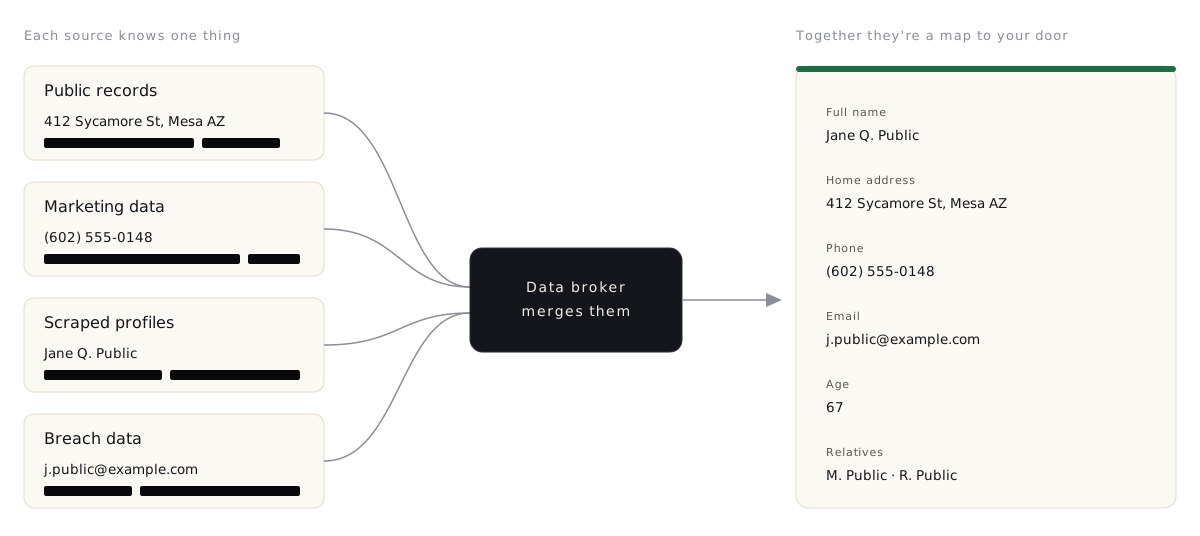
Almost none of the info floating around on the public internet came from a hack. It came from four ordinary sources:
- Public records: property deeds, voter registration, court filings, marriage and business licenses. These files are legally open, and increasingly available to be downloaded in bulk.
- Purchased marketing data, meaning loyalty programs, warranty cards, online forms, and app permissions, sold onward. Think your grocery store rewards membership.
- Scraped web content: social profiles, directories, and old accounts.
- Breach data: records from past breaches, recirculated.
Data brokers buy these streams and merge them into a single profile keyed to your name. People-search sites are the consumer-facing storefronts for that data, the ones that surface when someone searches you.
The scale is not small, and regulators have taken a serious interest: in December 2024 the FTC acted against the broker Mobilewalla for selling sensitive location data (including data revealing individuals' private homes) without verifying consent, alongside a parallel action against Gravy Analytics and its subsidiary Venntel. The agency's position is now that precise location data is inherently sensitive when it can reveal visits to clinics, places of worship, or treatment centers.
Step 1: Find out what is already public about you
Before removing anything, build a list. Search each of these and write down every site that returns a real listing for you:
- Your full name in quotes, plus your city
- Include searches with any aliases you may use, such as middle name, different last name, or maiden name
- Your name plus your phone number
- Your name plus your street address, or your name plus your city
- Your name plus a relative's name
- Your email address on its own
Use a private browsing window so your own search history does not personalize the results. Check at least the first three pages.
Many people find somewhere upwards of 20 listings. Having over 100 listings matching your info is not out of the ordinary. Record the site name, the URL of your profile page, and what it exposes. You will need those URLs again: several sites require you to paste your exact profile link into their opt-out form.
Step 2: Remove yourself from the major people-search sites
This is the highest-yield step. The largest aggregators feed the smaller ones, so removing the big ones first cuts off supply downstream.
Work through these first: Whitepages, Spokeo, BeenVerified, TruePeopleSearch, FastPeopleSearch, MyLife, Intelius, and Nuwber. Each of those links is a full walkthrough. The National Public Data opt out and the Nuwber opt out, for example, both hinge on copying the exact profile URL before you start.
Each follows roughly the same pattern:
- Find your profile and copy its URL.
- Locate the opt-out or suppression page, usually linked in the footer and often labelled "Do Not Sell My Info" or "Privacy."
- Submit the profile URL and an email address.
- Click the confirmation link in the email. This is where most opt-outs silently fail. An unconfirmed request is not a request.
- Save the confirmation. If the listing returns, a dated confirmation is your evidence.
A few sites add friction deliberately: phone verification, a mailed form, or an identity document. Our individual data broker opt-out guides document the exact steps and the specific place people get stuck on each site.
Step 3: Opt out of the data brokers behind them
People-search sites are the visible layer. Underneath sit the brokers that supply them, and removing yourself from a storefront does not remove you from its wholesaler.
The only comprehensive public lists of these companies are the state registries. California and Vermont both require brokers to register annually. Vermont's registry alone lists 283 companies. Work through the registry, find the brokers that hold consumer data, and submit a deletion request to each.
Be aware of the gap: the Electronic Frontier Foundation found in 2025 that hundreds of brokers register in one state but not others: 291 companies registered somewhere but not in California, 475 not in Oregon, 309 not in Vermont. Cross-referencing multiple state registries surfaces companies that any single list misses.
Step 4: Use California's DROP portal if you are eligible
California residents now have something no one else does: a single request that reaches every registered broker at once.
The Delete Request and Opt-out Platform (DROP), created by the California Delete Act and operated by CalPrivacy, went live on January 1, 2026. As of August 1, 2026, more than 600 registered data brokers are required to process deletion requests submitted through it, check the platform at least once every 45 days, and face escalating daily penalties for non-compliance. More than 300,000 Californians had filed requests through DROP by spring 2026.
If you are a California resident, do this before anything else. It is the single most effective action available, and it takes minutes.
Everyone else has to file individually for now. Vermont has directed its Secretary of State to study building a similar mechanism, but the report and proposed legislation are not due until December 2028.
Step 5: Remove outdated results from Google
Google's Results About You tool scans search results for your phone number, email address, and home address, and lets you request removal of the ones it finds. It will also alert you when new results appear.
One critical caveat, and it is the thing most guides get wrong: de-indexing is not deletion. Removing a result from Google hides the page from search. The page itself, and the profile on it, still exists, and anyone who visits the site directly still sees it. Worse, if you skip the underlying opt-out, the listing simply gets re-indexed later.
Treat Google removal as cleanup after Step 2, never as a substitute for it.
Step 6: Close the sources that refill your listings
Removal that is not paired with source control is temporary. Reduce what flows back in:
- Social profiles. Hide friend and family lists, remove your employer and hometown, and strip location metadata from photos.
- Property records are largely unavoidable, but some counties allow address confidentiality for qualifying individuals.
- Voter registration: a handful of states permit confidential status, but most do not.
- Old accounts. Dormant forum, retail, and directory accounts are routinely scraped. Delete rather than abandon.
- Future records: a PO box or virtual mailbox on new filings limits what gets picked up going forward.
Step 7: Recheck on a schedule
This is the step that determines whether any of the previous six held, and it is where most people's efforts quietly fail.
Consumer Reports ran the most rigorous test of this to date: a four-month study with 32 volunteers measuring how much personal data actually disappeared. The findings are sobering. Paid removal services eliminated only 35% of profiles on average. Doing it manually performed considerably better at around 70%. But in every case, at one week, one month, and four months, some data remained.
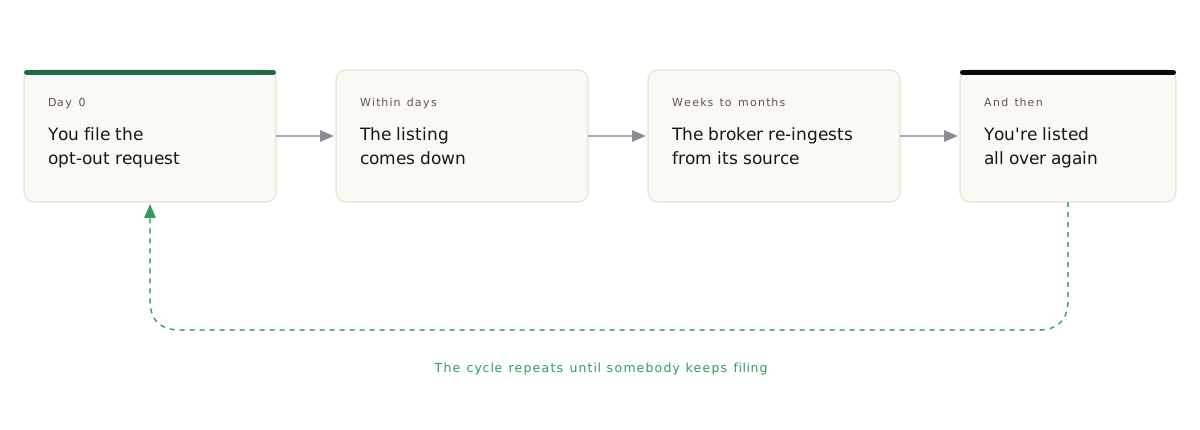
The reason is re-listing: brokers re-ingest from upstream sources on a refresh cycle, so a record you removed reappears when the supplier sends it again. Removal is not an event. Recheck your major listings quarterly and re-file where they have returned. This is what Delist My Data is being built to handle. Since there are so many possible sites that can list and relist your data, it makes sense to have an online service that can handle all of this for you, starting with showing you evidence of your current exposure.
Can you remove your information for free?
Yes, completely. Every opt-out described here is free. No people-search site can lawfully charge you to remove your own listing, and any that implies otherwise is worth reporting.
What this costs you is time. A first pass across the major sites takes a lot of time, and checking at least quarterly will then become required. The Consumer Reports data is the honest framing here: manual removal outperformed paid services by a wide margin. If you have the hours, doing it yourself is genuinely the better outcome, not the consolation prize.
Paid services trade money for that time — and their real value is the recurring recheck, not the initial sweep. If you are evaluating one, judge it on how often it re-verifies and whether it proves removals, not on how many sites it claims to cover. Delist My Data is being built to prove your online exposure through screenshots and links before and after we work to get your information removed.
Frequently asked questions
How do I remove my address from the internet? Your home address is the single most-republished fact about you, and it almost always traces back to people-search sites rather than to anything you posted. Opt out of the sites in Step 2 first: each listing carries your address and phone number together, so one removal clears both. Then request removal of any Google search results that still show it (Step 5); Google's "Results about you" tool accepts a home address as a removable item. Property records at the county recorder are the one source you generally cannot suppress, which is why a PO box or virtual mailbox on future records is the durable fix.
How long does it take to remove my info from the internet? Individual opt-outs take 24 hours to several weeks. A full first pass across the major sites realistically takes a few weekends. Keeping it removed is ongoing.
Can I get my information removed permanently? No service or method can guarantee permanence, because brokers continuously re-acquire data from public records. Anyone promising permanent deletion is overselling.
What if a site ignores my opt-out request? Re-file with your dated confirmation. If you are in a state with a comprehensive privacy law, cite your deletion right explicitly. California residents can escalate to CalPrivacy, which has been actively enforcing against non-compliant brokers.
Does removing my information affect my credit report? No. Credit bureaus are consumer reporting agencies governed by the Fair Credit Reporting Act, and are a separate system from what we call "marketing data brokers." Opting out of people-search sites has no effect on your credit file.
Do I have to do this in every state? Your removal requests are not state-specific, but your rights are. California residents have DROP and the strongest deletion rights. Other states vary considerably. File everywhere regardless — most brokers apply opt-outs nationally.
Will this stop robocalls and spam? It can reduce them over time, since brokers are a major source of the phone numbers sold to marketers. It will not stop calls from numbers already circulating.