USPhonebook.com is a free reverse-phone-lookup site: type in a number and it returns the name attached to it, the person's address history and their relatives, no account required. Most people find it the other way round, by searching their own name and discovering that their cell number is sitting on a public page. This article covers what the site is, what a USPhonebook search actually shows, whether it's legitimate, and how to remove yourself, with the click-by-click version in our USPhonebook opt-out guide.
What is USPhonebook.com?
The name suggests a directory, and usphonebook.com is closer to that than most of its rivals: the phone number is the key, and everything else hangs off it. It also runs an ordinary name search and an address search, all free to view, with ads paying for the page; the homepage promises "2.5+ Billion Records" and the footer copyright runs from 2016. Its privacy notice states plainly that "USPhonebook.com is not a Consumer Reporting Agency (CRA) as defined by the Fair Credit Reporting Act (FCRA)," which is the standard people-search position and the one we come back to below.
Who owns USPhonebook?
The answer comes from California's data broker registry rather than from the site. USPhoneBook.com is one of ten trade names registered by Mississippi Tornado Alley, LLC of Sacramento, alongside FastPeopleSearch, FastBackgroundCheck, CyberBackgroundChecks, SearchPeopleFree, PeopleSearchNow and four others. Older guides, including an earlier version of ours, described USPhonebook as a sister site of PeopleFinders under Confi-Chek, Inc.; the current registry shows Peoplefinders, LLC filing separately from San Francisco, and USPhonebook's own privacy notice names no parent at all. The one supplier the site does name is in its footer, which advertises "our partner EnformionGO's Fast Developer API"; Enformion is a wholesale data company that registers separately and, as far as the registry shows, operates none of these sites.
The same registration carries the company's own numbers for 2024, filed across all ten sites together: 1,204,017 requests to opt out of the sale of personal information received, 993,412 honoured in full, and 207,021 denied, with a median response time of one day. That is roughly one request in six turned down. The filing also states that an opt-out of sale submitted on any one of the ten sites "will apply across all sites," while the opt-out for data collected online has to be filed on each site separately. In our own removal work we have not seen a USPhonebook request clear a matching listing on FastPeopleSearch or the others, so we treat each site as its own job and suggest you do too.
What a USPhonebook search shows
Here is a real results page from our capture work, for the most common name in the country, with the identifying details blacked out.
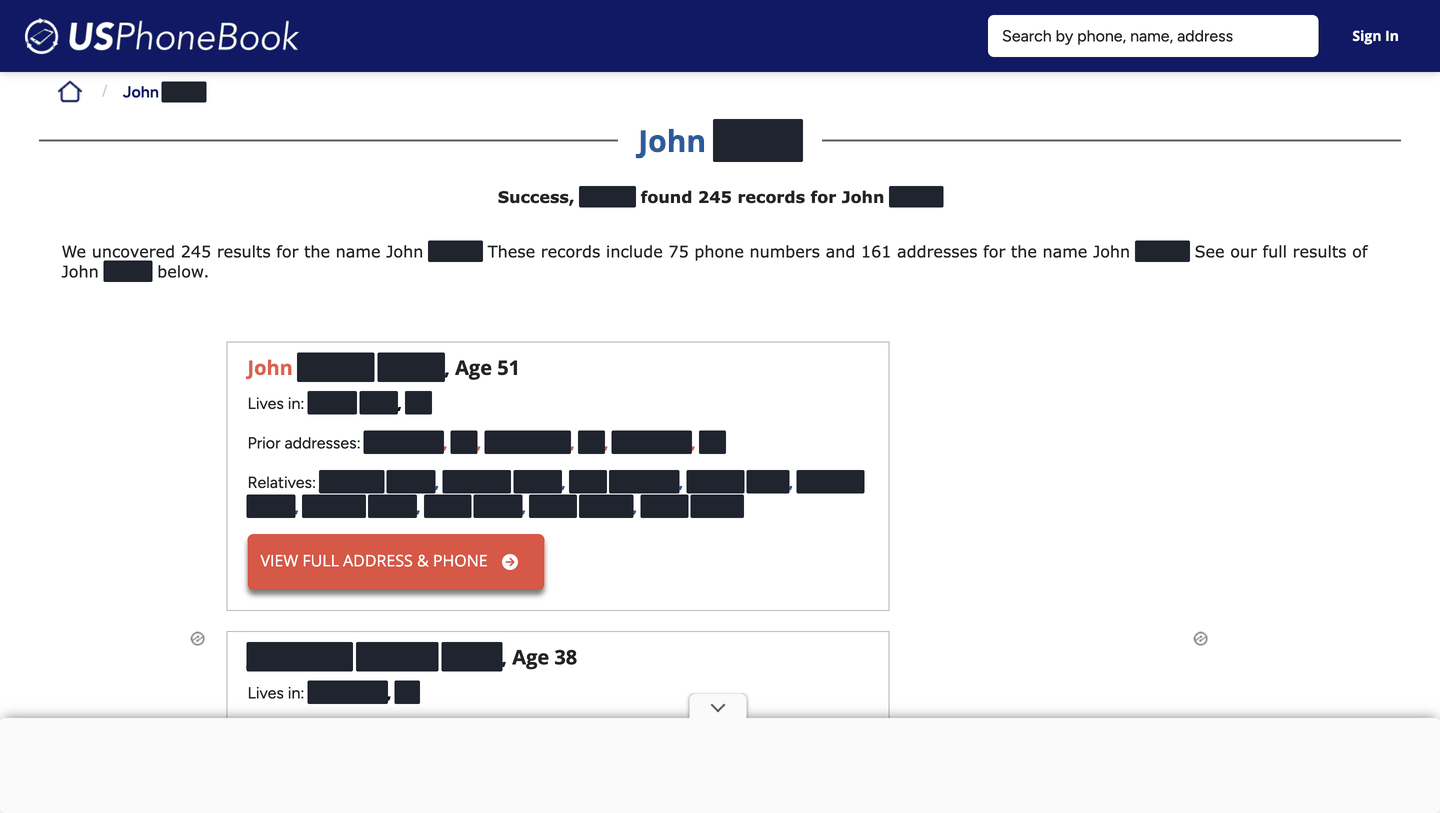
Two hundred and forty-five records for one name. Each card shows an age, a current city, past cities, relatives, and the phone numbers, with the digits partly masked on the list page and shown in full on the record. Open one and you get the full address history, every landline and mobile the site has associated with the person, and a "possible relatives" block with ages.
Two observations from running the site through our own scanning engine.
The first is about reach. Our engine reads USPhonebook records at a direct URL of the form usphonebook.com/first-last/state, without touching the search box. That URL pattern is worth knowing if you're checking yourself: it lets you look at the exact page a stranger would land on from Google, which is where most people actually meet this site.
The second is about the page itself. The cookie-consent dialog is a third-party widget rendered inside a browser shadow root, and the page runs several ad slots plus a floating video ad. Ordinary automation can't dismiss the consent box, and our capture tooling had to be taught to. For a reader this mostly means: if the site hangs or the consent banner won't go away, a private window usually clears it.
Is USPhonebook legit?
It's a real site showing real data, and there is nothing to buy on it, so it isn't a payment scam. The "is usphonebook legit" search usually comes from someone who just saw their own cell number on a public page and wants to know if that can be right.
It can be. Phone numbers reach the site through the same channels as everything else in this industry: public records, old directory data, and commercial marketing files where you once typed your number into a form. The number is real more often than the rest of the record is. The address may be years stale, the "relatives" may include a former housemate, and the same person often appears twice because two sources spelled the name differently.
Is it legal for USPhonebook to publish this?
Yes. Republishing public-record and directory data is legal in the US, and the FCRA disclaimer quoted above is what keeps the site outside the one federal law that would give you dispute rights. Because USPhonebook says its data can't be used for hiring, housing or credit decisions, it owes you no process for correcting an error, and anyone can look you up for any other reason. It does run an opt-out link in its footer, which is the state-law route and leads to the same removal form; the form's own preamble says the right applies "depending on your state of residence," and we cover what that phrasing has meant on the sister sites in our FastBackgroundCheck profile.
What being listed on USPhonebook means for you
A reverse phone lookup is the specific risk here. Every other site starts from a name; this one lets a stranger start from a number. A missed call, a number on a flyer, a digit string in a group chat: any of those becomes your name, your home address and your relatives in one search. That is the starting kit for doxxing and for the spoofed "this is your bank" calls that are more convincing when the caller already knows your address.
For most people the practical effect is spam calls that know your name. For anyone dealing with a stalker or an abusive ex, a free reverse lookup on your cell number is a page to remove today.
How to remove yourself from USPhonebook.com
The opt-out is free and takes a few minutes plus a wait for an email. Go to usphonebook.com/removal, or use the opt-out link in the footer. The page is headed "US Phone Book Opt-Out Form," and it runs in the order the Mississippi Tornado Alley sites all use: you give your first and last name and an email address first, before you've pointed at any record. The site then emails you a link to the actual removal form, and that link is good for 24 hours; wait longer and you have to request a new one. On the emailed form you enter your details so they match the listing, land on a confirmation page, and are asked to "allow 3 days for your request to be fully processed."
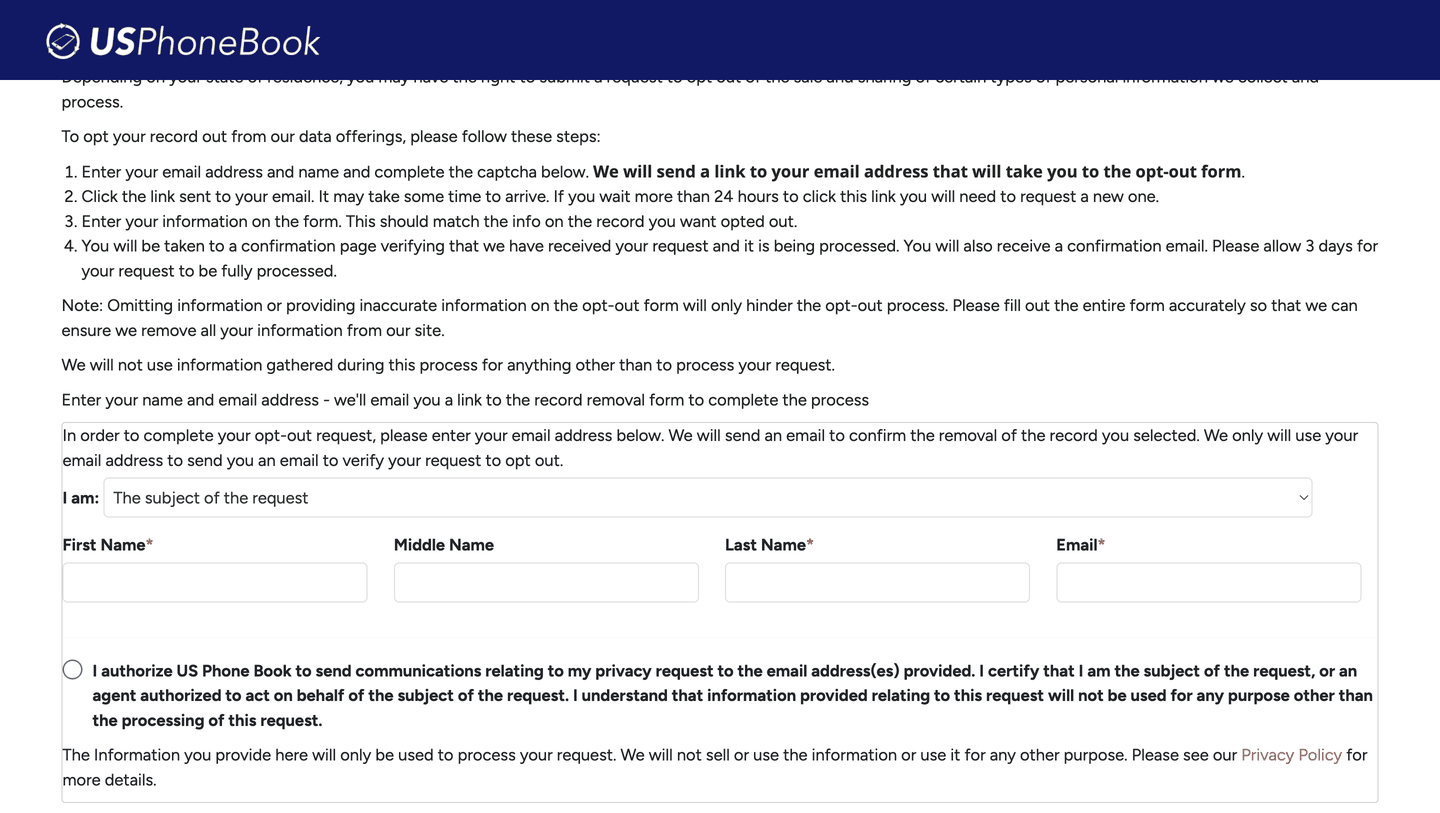
The form is worth a second look if you've already done one of the sister sites. When we compared it with PeopleSearchNow's opt-out page in September 2026, the four-step instructions, the "I am" dropdown, the field names and the authorization wording matched line for line. The only differences were the brand name and the one-sentence preamble about your state of residence, which USPhonebook carries and PeopleSearchNow doesn't. One operator, one template. Do the sister sites next, because a removal here clears nothing there; our FastPeopleSearch and FastBackgroundCheck guides cover two of them. Our USPhonebook opt-out guide walks every screen of this one.
Common questions
Is the US Phone Book the same as USPhonebook? People search for "us phone book" and "the us phone book" meaning this site; the domain is usphonebook.com.
Is usphonebook free? Searching, reverse lookup and removal are all free. There's no paid tier on the site itself.
Why is my cell number on USPhonebook? It came from a public record, an old directory, or a marketing file, and the site matched it to your name and address. You weren't asked.
Does a search notify the person? No. Reverse lookups are invisible to the person being looked up.
How long does removal take? The form asks for 3 days after you complete the emailed step. Search your number again after a week, and resubmit if the listing is still there.
Will my listing come back? It can, when a new number or address reaches the site's sources. That re-listing cycle is why we recommend rechecking every few months.
A reverse-lookup site is one you check by number, not just by name, and that's an extra thing to remember every quarter. Delist My Data is built to remember it for you, on USPhonebook and across the rest of the people-search sites, and to re-file when a listing comes back. We're in pre-launch; founding-member access starts with the waitlist.