PeopleFinders.com is one of the oldest people-search sites still running, a paid background-report business with a free teaser layer that shows your name, age, cities and relatives to anyone who searches. If you've just found yourself on it, this page explains what the site is, what a PeopleFinders search shows, whether it's legitimate, and how to remove your listing for free, with the step-by-step in our PeopleFinders opt-out guide.
What is PeopleFinders.com?
PeopleFinders aggregates court filings, property records, voter rolls and old phone listings into name-keyed profiles, and it has been doing so for long enough that most adults in the US have a record on it; the copyright line in its footer runs from 1999. The free search returns a card; the full report, with address history, phone numbers, email addresses and background-check extras, is behind a subscription. That puts it in the paid camp with Spokeo and BeenVerified rather than the ad-supported free sites.
Who owns PeopleFinders?
For years the site was run by Confi-Chek, Inc. of Sacramento, the defendant in Eisenberg v. Confi-Chek, an Illinois right-of-publicity class action over peoplefinders.com filed in Cook County. The settlement, reached in 2024, created a $4,896,540 fund for Illinois residents whose profiles were displayed and clicked on the site between November 2, 2021 and January 1, 2023; the claims window closed on October 7, 2024, and the settlement site estimated payments of $89 to $178 per claimant. California's current data broker registry lists the operator as Peoplefinders, LLC of San Francisco, with a second trade name, FindANeighborhood. Older guides, including an earlier version of ours, described USPhonebook as its sister site; the registry now places USPhonebook under a different company, Mississippi Tornado Alley, LLC.
The registration also carries the company's own request figures for 2024: 1,031,034 requests to opt out of the sale of personal information received, 941,600 honoured in full and 89,434 denied, with a median response of one day. Requests to know what the company holds fared worse: 217 received, 124 denied, and a median of 30 days to answer. PeopleFinders' own site returned an access-denied page to every non-browser request we made while writing this, so the figures above and our own browser sessions are what this profile rests on.
What a PeopleFinders search shows
Search a name with a city and state and you get a list of cards. Each shows the name, an "Also Known As" line with aliases, a number, a city and state, and possible relatives.
That number is the person's age. Nothing on the card says so. Our scanning engine, which reads result pages to work out whether a listing is a real match, initially couldn't see it: the card reads something like "Also Known As … 33 Seattle, WA," with the age sitting as a bare number between the aliases and the location, and our matcher was looking for an "Age" label that isn't there. We ended up writing a separate name-plus-location extractor just for pages like this. For a reader the point is simpler: the site shows your age to anyone who searches, even though it never uses the word.
The full report adds the usual: current and prior addresses, landline and mobile numbers, emails, relatives with their own ages, and, depending on tier, criminal-record and property lookups. All of it is machine-assembled from public records and commercial data, with the accuracy problems that implies.
Is PeopleFinders legit?
As a company, yes: a real operator, a real product, and a subscription that does what it says. The "is peoplefinders legit" question tends to be about two other things.
One is billing. PeopleFinders sells auto-renewing subscriptions, often entered through a low-priced trial. People who forget to cancel find recurring charges, which drives a share of the "scam" complaints. Read the trial terms before you buy a report.
The other is accuracy, and there the record is mixed in the way it is for every aggregator. Two sources with different spellings become two profiles. A previous tenant becomes a relative. An address you left in 2018 stays "current" because the source that fed it hasn't been refreshed. The site's data is real and wrong at the same time: a real phone number next to a stale address is still enough to find you.
Is it legal for PeopleFinders to publish this?
Yes. Republishing public records is legal in the United States. PeopleFinders, like the rest of the industry, disclaims being a consumer reporting agency and says its reports may not be used for hiring, tenant screening, credit or insurance decisions under the Fair Credit Reporting Act. That disclaimer is what keeps the site outside the one federal law that would give you the right to dispute an error. State privacy laws are where obligations are growing: the site's footer "Do Not Sell My Personal Information" link exists because of them, and it's the route to the opt-out form.
What being listed on PeopleFinders means for you
The free card alone gives a stranger your age, your city history and your relatives' names. That's enough for the "grandparent" phone scam, which works by naming a real relative, and it's the first page of the file a doxxer assembles. The paid report adds your phone numbers and address, so anyone with a few dollars and no stated reason can get to your door.
Because PeopleFinders is old and well linked, its pages also rank well for people's names. It's common for the site to sit on the first page of a Google search for you, above anything you've chosen to publish.
How to remove yourself from PeopleFinders.com
The opt-out is free and takes about ten minutes. The page isn't linked from the homepage: go directly to peoplefinders.com/opt-out, or use the footer's "Do Not Sell" link.
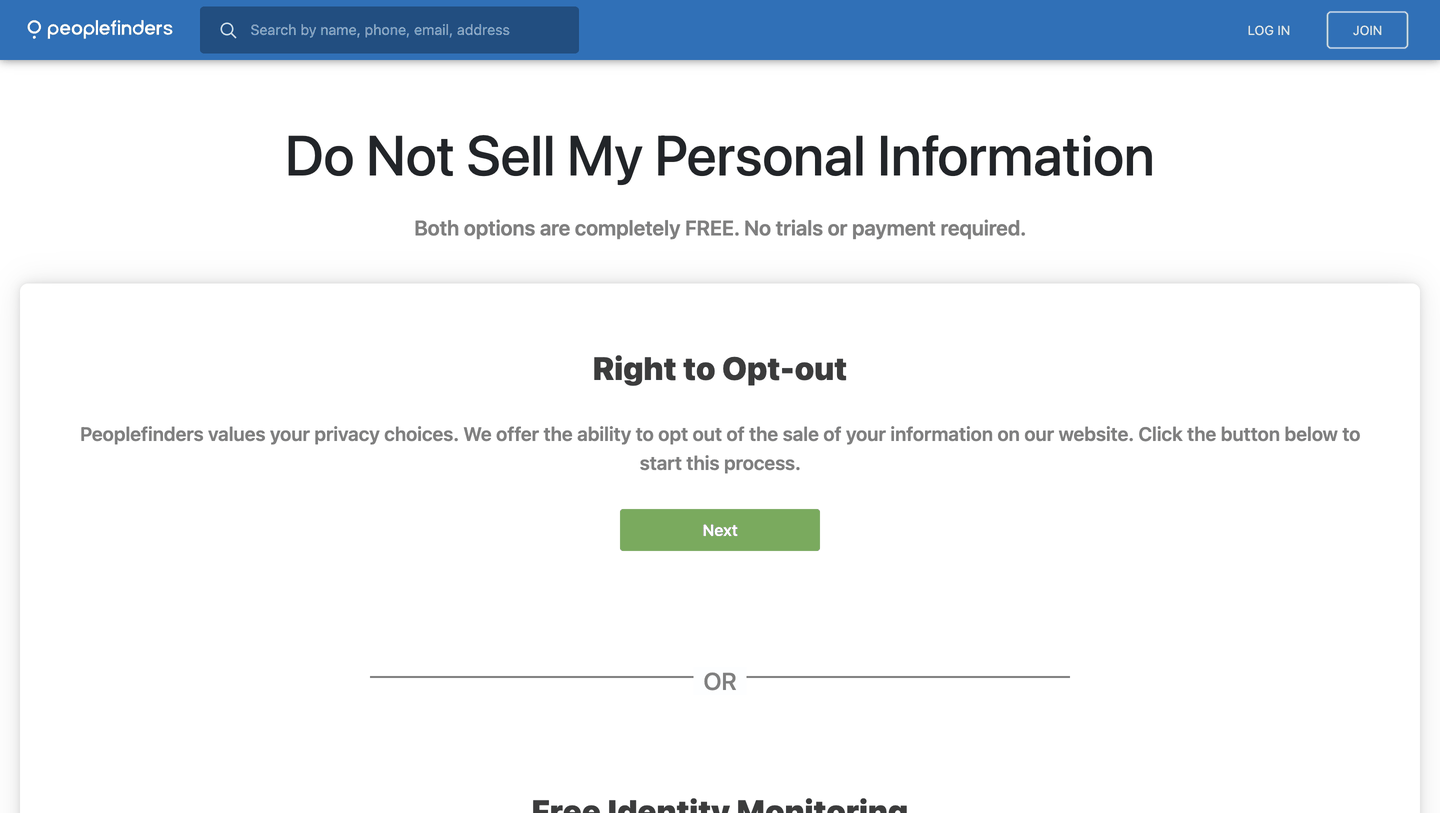
One thing to notice in that capture: the page offers "both options" free, and only the top one is a removal. The second panel, "Free Identity Monitoring," is a sign-up for a PeopleFinders product, and it doesn't take your listing down. Click Next under "Right to Opt-out." What opens is headed "Record Suppression Form," and it asks for more than most: first, middle and last name, an email address, a phone number, your date of birth, and a street address with city and state. The site says it will "locate your record and remove it from our system within 3 days," and it warns that you can't edit the form after you submit, that special characters in a name should be left out ("Brown Jr" rather than "Brown, Jr."), and that a record it couldn't match from what you typed "may reappear on our site" when new data arrives. In other words, a thin submission is how you end up filing twice. Give it the full record, use an email you check, and search yourself again after a few days. Our PeopleFinders opt-out guide walks every screen.
Then go and do USPhonebook, which many people find themselves on at the same time; that form is in our USPhonebook guide. For everything else you appear on, our full removal guide is the map.
Common questions
Is PeopleFinders free? The search and the summary card are free. Reports require a paid, auto-renewing subscription. Removal is free.
Does PeopleFinders do background checks? It sells background-style reports, but they're not FCRA-compliant and can't legally be used for hiring or tenant decisions.
Does a PeopleFinders search notify the person? No. Searches are invisible to the person searched.
Why does PeopleFinders have my age? It's derived from public records, typically a birth year in a voter or property file, and shown as a bare number on the card.
How long does removal take? The form says within 3 days, which matches our experience. Search yourself again after a week.
Will my listing come back? It can, when a new record under your name reaches the site's sources. That re-listing cycle is why removal is a recurring check rather than a one-off.
More than twenty-five years of records means a lot of ways for a profile to be rebuilt. Delist My Data is being built to keep watching PeopleFinders and the other people-search sites after the first removal and to file again when you resurface. We're in pre-launch; the waitlist is where founding-member access begins.