ThatsThem is a free people-search site that shows names, ages, addresses, phone numbers and email addresses with no paywall, and since at least 2025 it has been operated by Spokeo, Inc., the Pasadena company behind spokeo.com. If you got here by searching "thats them" or "that's them" after spotting yourself in a result, this page covers what the site is, who actually runs it, what a listing contains, what people complain about, and how to remove your record for free.
What is ThatsThem?
ThatsThem.com describes itself as a "100% Free People Search" offering reverse name, address, phone and email lookups. Its homepage claims roughly 2.2 billion names, 1 billion phone numbers, 1.7 billion email addresses and 800 million street addresses, "aggregated from more than 50 sources each of which is updated monthly." Those figures count records, not people; one person can account for a dozen of them across old addresses and discarded numbers.
The domain was registered in April 2012, and for most of its life the site presented as an independent operation. The Better Business Bureau opened a file on it in April 2020 at an address in Montgomery Village, Maryland, with a Maryland phone number, and that is still where the BBB places it. The site itself has never been forthcoming: the footer says only "Copyright © 2026, ThatsThem.com," and the privacy and terms pages that most people-search sites use to name their operator return errors as of this writing.
What sets it apart from the paid sites is the business model. TruthFinder and BeenVerified show you a teaser and charge for the report. This site shows the record itself, free, and earns from the ads around it. That is why its pages rank so well in Google for people's names: there is real content on them, not a paywall.
Who owns ThatsThem?
Spokeo. Three separate records say so, and none of them is on thatsthem.com.
The first is California's data broker registry, which every broker selling Californians' data must file with each year. Spokeo, Inc.'s 2026 entry lists its trade names as "Spokeo.com; Freepeopledirectory.com; Thatsthem.com; Peoplewin.com; Anywho.com; Family.me." The same entry discloses that Spokeo "collects and sells credit header information that is subject to the GLBA," meaning identifying and contact data drawn from credit files, which it says is under five percent of its business and is sold only to qualified businesses and government agencies.
The second is Spokeo's own privacy policy. It tells you to use the Spokeo opt-out tool for "Spokeo.com and other Spokeo-operated websites excluding Thatsthem.com," then adds a separate clause: "To request that Public Information about You be removed from public listings on Thatsthem.com, please use the Thatsthem.com Optout tool at https://thatsthem.com/optout." A company doesn't write removal instructions for a site it doesn't run.
The third we found ourselves. Load the ThatsThem homepage and look at the page source: the site's own JavaScript is namespaced Spokeo, with objects like Spokeo.context and Spokeo.gaqComplete. It is built on Spokeo's front-end code.
None of that appears on the site, which is a fair thing to hold against it. It also means the company's history is Spokeo's history: an $800,000 FTC penalty in 2012 for marketing profiles to employers without complying with the Fair Credit Reporting Act, and a 2016 Supreme Court case that began with a man suing over an inaccurate Spokeo profile. Our Spokeo profile covers both.
What a ThatsThem search shows
Run a name search and you get a results page listing every match, each with an age, a current city, and a set of past addresses. Open one and the record typically expands to:
- full name and any known aliases or previous names
- age and, sometimes, birth month and year
- current address plus a history of prior addresses going back years
- landline and mobile phone numbers, each flagged as such
- email addresses linked to the name
- a "possible relatives" and "associates" block
- for some records, vehicle information and the internet provider tied to an address
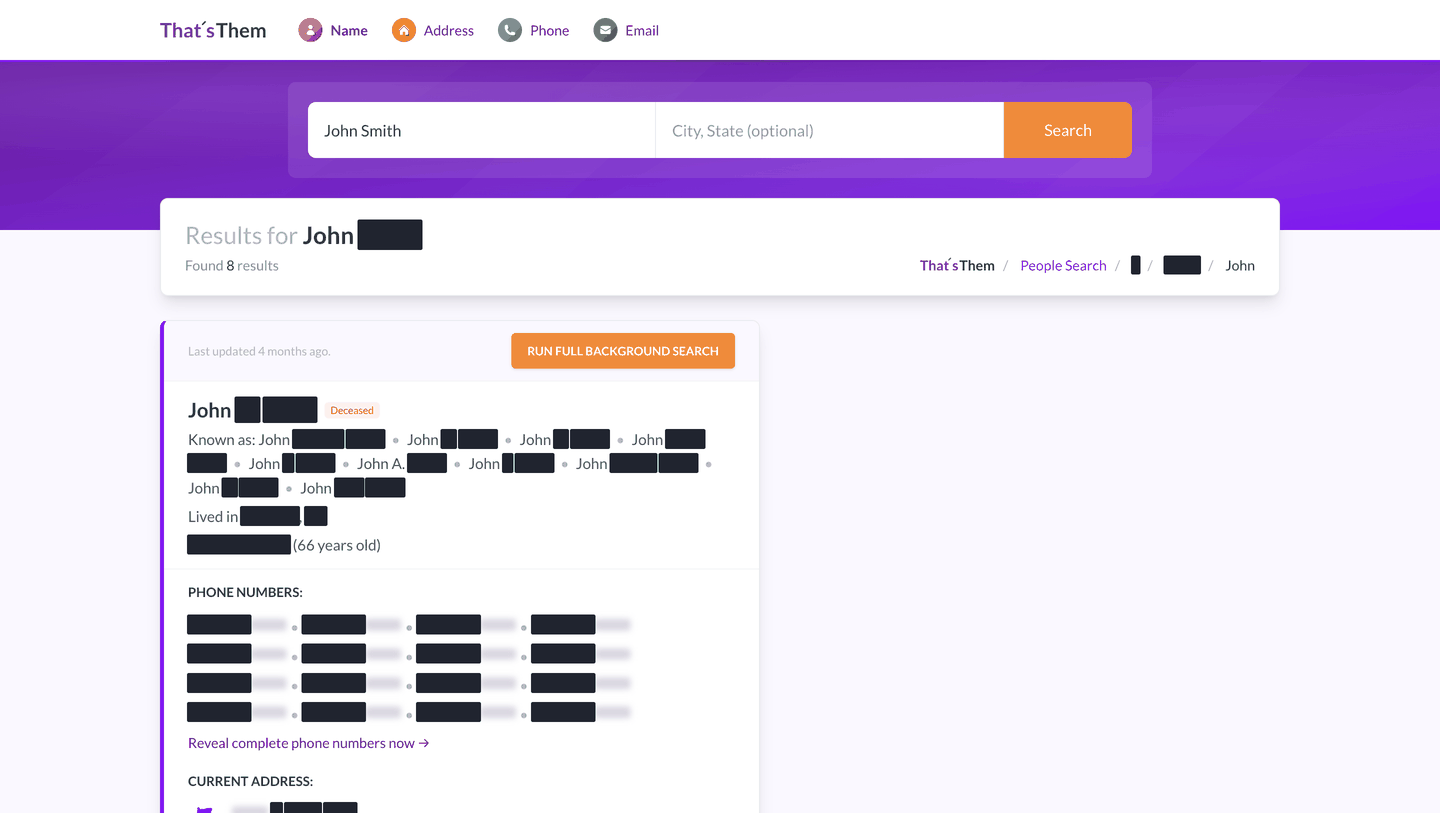
The screenshot above is a real results page from our own capture work, with the surnames and contact details blacked out. We use "John Smith" for these because it is the most common name in the country, which keeps any individual on the page anonymous, but the layout is what you would see searching your own name.
Two things from our scans are worth knowing before you panic about the coverage numbers.
The first is that the free results are patchier than "2.2 billion names" implies. When we ran a test identity through the site during our coverage checks, a person who appears on more than a dozen other people-search sites at the correct age and city, ThatsThem returned nothing for them, both with a state filter and nationwide. It has a lot of records. It does not have everyone, and being absent today is no guarantee about next month.
The second is where the search box can send you. When our scripted browser submitted the site's own search form, the page it landed on was not a ThatsThem results page but a Spokeo sales funnel. At the time we filed that as cross-promotion between two sites. Knowing what we know now, it is a free front door leading to the paid product of the same company. If you find yourself being asked for an email address to "unlock" results, you have crossed over.
Is ThatsThem legit?
It is a real site that shows real data, and there is nothing to buy on it, so it isn't a payment scam. The "is thatsthem legit" question people are really asking is whether the information is accurate, whether the company is straight with you, and whether the data should be public at all.
On accuracy, treat any record as a sketch. Records are merged by name, address and phone, and the merge is automated. The failure modes are the ones we see across every aggregator: an old address shown as current, a phone number that belonged to the previous occupant, a relative who is actually a former roommate, and separate records for the same person under a middle initial or a maiden name.
On candour, the picture is mixed. The opt-out is genuinely free and simpler than most. But the site doesn't tell you who runs it, and it doesn't tell you that its search box feeds a paid funnel.
On whether the data should be public, the records are assembled from public records and commercial data, and republishing them is legal in the United States. That is not the same as harmless. A page that puts your home address, your cell number, your age and your relatives' names in one place is the standard starting kit for doxxing, for the "grandparent" phone scams that need a relative's name to work, and for anyone who wants to turn up at your door.
What people complain about
The BBB gives ThatsThem a D+ and lists 11 complaints in three years, one of them unanswered. Small numbers next to its sister site Spokeo, but the content is consistent. Every complaint we read is about the same thing: the site published someone's details, and getting them down was harder than the opt-out page suggests.
A March 2025 complainant wrote that they had "had to change my numbers and even MOVE out of fear for my safety" and that the site had not deleted their record after a request. A September 2025 complainant said they "received confirmation it would be removed within 5-7 business days" and were "well over the time frame." One from May 2026 tried to email the company and got "continuous error messages." Another, from 2024, blamed the site for a phone "flooded with spam."
Two details there matter for anyone filing. The "5-7 business days" in that confirmation email is not what the opt-out page says, which is "typically processed within 72 hours." And there is no working email route: the opt-out form is the only door, and if it doesn't take, the BBB is where people end up.
Is it legal for ThatsThem to publish this?
Yes, under current federal law, with one important limit. The site is not a consumer reporting agency, so its data cannot lawfully be used for hiring, tenant screening, credit or insurance decisions under the Fair Credit Reporting Act. That disclaimer protects the site more than it protects you: it means anyone can look you up for any other reason, and it means there is no dispute process if the record is wrong. Spokeo, the operator, is the company whose FCRA marketing the FTC fined in 2012, so the line is one it has been made to learn.
State law is where the picture is changing. California's Delete Act and the DROP platform it created, plus the newer data-broker registration laws in Texas, Oregon and Vermont, all put obligations on brokers, and Spokeo's California registration is how we know who runs this site at all. None of those laws yet requires a site to take you down without being asked.
How to remove yourself from ThatsThem
The opt-out is free, takes about five minutes, and is one of the simpler ones we have documented. Go to thatsthem.com/optout and fill in the form: full name, street address, city, state, ZIP code, email and phone. The site uses the address and phone to find the right record, so they need to match what the listing shows. Submit, and that is the whole request.
What makes it unusual is what is missing. Of the 39 opt-out flows we have walked and screenshotted, most send a verification email you have to click, and several make you click an emailed link within 24 hours or start over. ThatsThem sends no verification link at all. The page states that "Requests are typically processed within 72 hours. You'll receive a confirmation email once complete," and that confirmation is a receipt, not a step.
The site is also candid about the limit of what you are getting: "Opting out removes your data from That'sThem's public search results. This does not affect data held by other services or public records." That includes Spokeo itself. A ThatsThem opt-out does not touch your spokeo.com listing, and Spokeo's policy says the reverse is also true, so file both: our Spokeo opt-out guide covers the other half. Every other site keeps its own form too; our full removal guide maps the lot.
Our step-by-step ThatsThem opt-out guide walks every field with screenshots, including what to do if you have records under more than one address.
Common questions
Who owns thatsthem.com? Spokeo, Inc. of Pasadena, California, according to California's data broker registry and Spokeo's own privacy policy. The site doesn't say so itself.
Is thatsthem.com free? Yes, both to search and to opt out of. There is no paid tier on the site; the paid product is Spokeo. Do not pay a third party to submit the form for you.
Why does ThatsThem have my information? It was assembled from public-record aggregators and commercial data feeds. You never signed up, and it never asked.
Does a ThatsThem search notify the person? No. Nobody is told when their record is viewed.
How long does removal take? The page says 72 hours. Confirmation emails quoted in BBB complaints say five to seven business days. Search yourself again after a week.
Will my listing come back? It can. The site refreshes from its sources monthly, and a new address or phone number can generate a fresh record that your earlier opt-out does not cover. That re-listing cycle is why we recommend rechecking every few months.
Is "thats them" the same site as "that's them"? Yes. The site styles itself That'sThem, but the domain is thatsthem.com and people search for it both ways.
That recheck is the job Delist My Data is being built to do for you: file the ThatsThem removal and the Spokeo one, keep looking, and file again when a fresh record turns up. We're in pre-launch, and the waitlist is where founding-member access starts.