FamilyTreeNow.com is a free people-search site built on genealogy-style data, which is why its records show your relatives, past addresses and birth year more plainly than most sites of its kind. People usually find it by searching "family tree now" after a relative mentions seeing the whole family listed on one page. This article covers what the site is, who runs it, what a record contains, whether it's legitimate, and how the two-pass removal works, including a correction to our own earlier description of it.
What is FamilyTreeNow.com?
The name suggests an ancestry hobby site, and the design leans into that: a green tree logo, a "Start Family Tree" button, a "My Tree" tab, a footer promising "100% Free Genealogy". Underneath, it works like any other people-search site. You type a first and last name and it returns a list of living people matching that name, each with an age, a birth date, the city they live in, cities they've lived in, and a row of relatives.
What differs is the emphasis. Whitepages or ThatsThem lead with a phone number and a street. This one leads with the family: who you're related to, where the family has lived, and roughly when each person was born. That is the data genealogists want, and it's also what makes a record easy to connect to the right person, which cuts both ways for you.
Who owns FamilyTreeNow?
The site's own pages don't say. California's data broker registry does: the 2026 registration is filed by Family Tree Now, LLC, from a Los Angeles post-office box, with a privacy line at (877) 838-4889. The same filing reports its 2024 numbers, and they are worth a pause. The company received 188,695 opt-out requests that year, granted 141,866 and denied 46,829, so roughly one request in four was refused. (It also received 631 deletion requests and granted every one.) That denial rate is unusual for a site that advertises a free removal; Whitepages, for comparison, reported 975 denials out of 34,722 in the same registry.
Two more things a normal browser shows you. The footer carries a link to TruePeopleSearch.com, a free people-search site registered by a different company, Free Data Services, LLC. And the site refuses every request that doesn't come from a real browser; our tooling gets a 403 on every page, which is why the captures below were taken by hand. We note the cross-promotion without claiming the two sites share an owner, because no first-party page says so.
What a FamilyTreeNow search shows
A familytreenow.com search for a common name returns a long list. Our capture below is the real results page for "John Smith", which we use for every site because it is the most common name in the United States and keeps any single person on the page anonymous. We blacked out surnames, birth dates, cities and relatives before publishing; the layout and field labels are untouched.
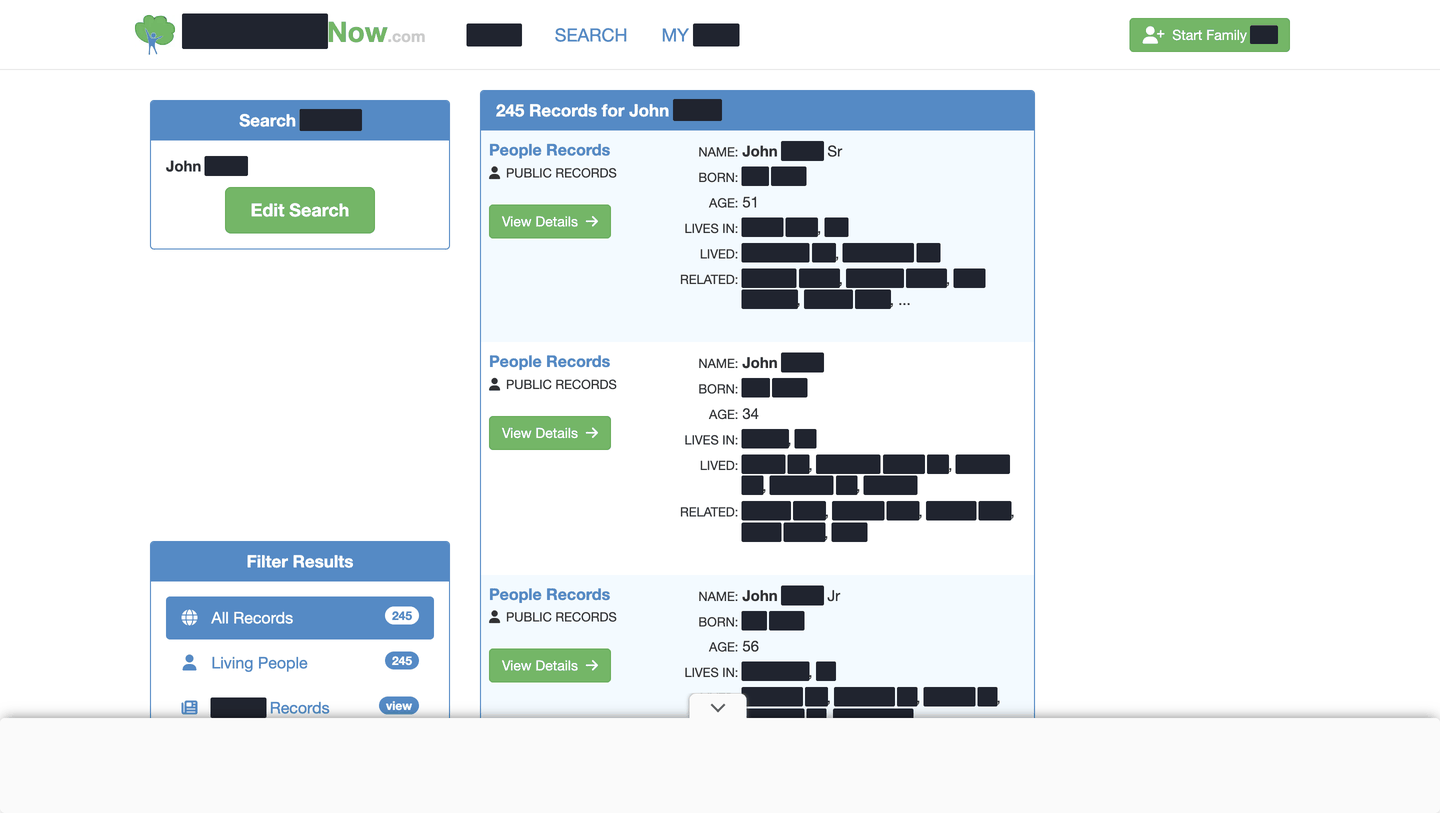
Each entry is labelled "People Records" and "Public Records" and carries the same rows: NAME, BORN, AGE, LIVES IN, LIVED, RELATED. The first and third entries in our capture are a "Sr" and a "Jr" with different ages, which is the site's genealogy lineage at work; on a phone-directory site those two would usually be one merged, wrong record. The RELATED row runs to seven or eight names before it trails off with an ellipsis, and the LIVED row lists multiple past cities per person.
A filter panel on the left splits the 245 results into "All Records" and "Living People" (both 245 here). Clicking "View Details" opens the individual record, which is where the site stops being a directory and becomes a family map: click a relative and you land on their record, with their relatives, and so on outward. In our scans, a single confirmed match here typically hands us more verified relatives than the same person's Spokeo or BeenVerified preview, and we're a removal service with a full identity on file. A stranger starting from your name alone gets the same tree.
Is FamilyTreeNow legit?
If "is familytreenow legit" means "is it a scam that will charge my card," no. Searching is free, opening a record is free, and the opt-out page states outright that "This process is completely free."
If it means "is the information right," treat it the way you'd treat any automated merge of public records. The genealogy framing makes the relatives block look authoritative, but it is assembled from shared addresses and surnames, so a former roommate, a landlord, or a stepfamily from a marriage that ended years ago can all appear as "related." Birth dates are more often right than on phone-first sites in our experience, because the sources that feed a family tree tend to carry them. Cities are a mix of current and long-stale. A record with your correct birth year, a city you left in 2009, and a relative you haven't spoken to in a decade is normal here.
A page that gets your birth year and your mother's name right feels verified, and readers tend to trust the rest of it. Don't. The site doesn't claim to check anything, and it offers no way to dispute an entry.
Is it legal for FamilyTreeNow to publish this?
Yes, under federal law as it stands. The site's footer says it "is not a Consumer Reporting Agency (CRA) as defined by the Fair Credit Reporting Act," so its records aren't covered by the Fair Credit Reporting Act. That has two consequences. Nobody may lawfully use a record from it to decide on your job, apartment, credit or insurance. And because it sits outside the FCRA, it owes you no accuracy standard and no dispute process; opting out is the only lever you have.
State privacy laws are starting to reach sites like this one. California's Delete Act, and the broker-registration laws in Texas, Oregon and Vermont, impose duties that free-to-view sites have historically ignored. None of them currently forces a site to remove you unasked, so the practical route stays the same: file the request yourself, or have someone file it for you.
What being listed on FamilyTreeNow means for you
The risk is specific to the family emphasis. The bullets below aren't equal in weight, and the last one is the one we'd act on first.
- Search engines index the record pages, so a familytreenow.com result can sit on the first page of Google for your name.
- Security questions. Mother's maiden name and the city you grew up in are common account-recovery answers, and this site puts your relatives' names and past cities on the same page as yours.
- Relatives appear whether or not they want to, which means opting yourself out doesn't remove your children, parents or siblings; each of them is a separate record and a separate request.
- Doxxing and impersonation. A page linking your name to your relatives and past cities is the starting kit for doxxing, for the "grandparent" phone scams that need a grandchild's real name to work, and for anyone trying to pass as a family member to a bank or a school. Of everything a people-search record exposes, the relatives row is the hardest to change after the fact: you can move house and change a number, but you can't get a new mother.
How to remove yourself from FamilyTreeNow.com
Removal is free, and runs in two passes. The first pass is the "Privacy Request" form at familytreenow.com/optout, shown in our capture.
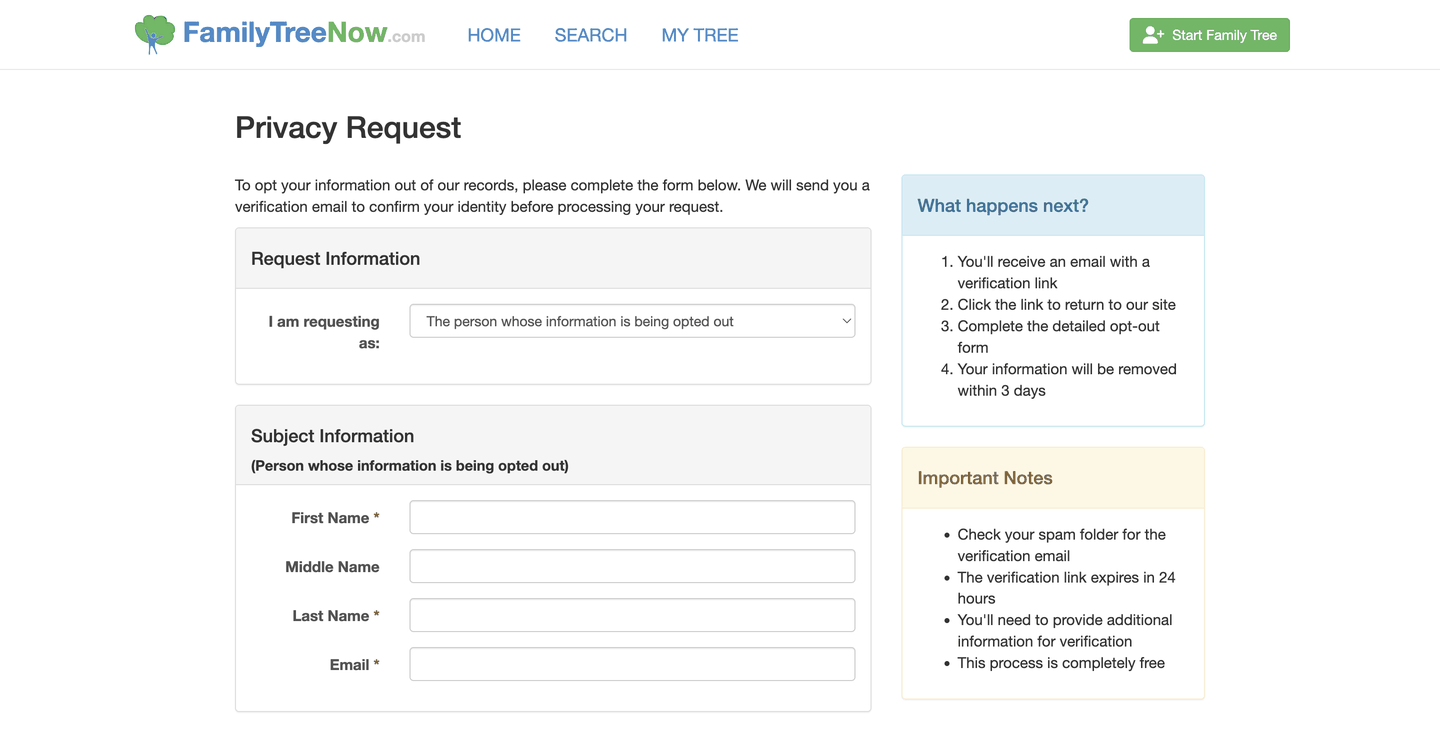
- Set "I am requesting as" (the default is "The person whose information is being opted out"), enter your name and email, and click "Begin Privacy Request."
- Open the verification email. The page's own notes say "The verification link expires in 24 hours" and tell you to check your spam folder; if it lapses, start again from step 1.
- The link returns you to the site and opens the detailed opt-out form, where, in the site's words, "you'll need to provide additional information for verification." This is the step that files the removal; the first form only proves you own the email address.
- Wait. The page says your information "will be removed within 3 days," one of the few processing windows in this industry a site publishes itself.
A correction, because it affects what you'll see. An earlier version of our own guide described a search tool on that page and a red "Opt Out This Record" button next to each result. Neither exists. When we reviewed our screenshot against the prose, the image contradicted the text: the page is a form, not a search, and the button says "Begin Privacy Request." The stale description had come from third-party removal sites, where it still circulates. We fixed ours; if an older guide elsewhere has you looking for a red button, that's why you can't find it.
Given the one-in-four denial rate in the registry filing, don't assume silence means success. Search yourself after the 3 days, and if the record is still up, file again and say in the form why the listing is a safety concern. The full FamilyTreeNow opt-out guide walks each step with screenshots. For the rest of the sites carrying the same records, see our full removal guide.
Common questions
Is familytreenow.com free to use? Yes, for both searching and opting out. There's no paid tier that we encountered, and the opt-out page says the process is free.
Who owns familytreenow.com? Family Tree Now, LLC, registered as a data broker in California from a Los Angeles post-office box. The site itself names no operator.
Does opting out remove my relatives too? No. Each person is a separate record, and the form asks whether you're requesting for yourself or as "an authorized agent on behalf of someone else," which is the route for filing on a family member's behalf.
How long does removal take? The site says within 3 days of completing the detailed form. Search yourself again after that.
Why can't I find the "Opt Out This Record" button? Because it isn't there. Older guides describe a search-and-button flow the current page doesn't have; the page is a Privacy Request form followed by an emailed link.
Why does the site have my family's information? It assembles records from public-record and genealogy-style sources that link people by shared addresses and surnames. Nobody in your family signed up.
Will my record come back? It can. Because matching here leans on relatives and past addresses rather than a phone number, the site has more ways to rebuild a profile after removal than a name-and-phone listing would: a new property record or a relative's fresh entry can reconnect you. That is the re-listing cycle, and why one opt-out isn't a permanent fix.
Relatives and old addresses give this site more ways to rebuild you than most, which is why a one-off removal here tends not to hold. Delist My Data is designed to keep watching FamilyTreeNow and the others and file again when that happens. It's in pre-launch; the waitlist is where to start.