CocoFinder is a free people-search site that publishes names, ages, addresses, phone numbers and relatives on pages Google can index, and it earns money by steering visitors into paid background-check reports run by other companies. If you searched "cocofinder" or "coco finder" after finding yourself on one of its name pages, this article explains what the site is, what a listing shows, whether it's legitimate, and how to remove yourself, including the detail that its official removal form is currently dead and what to do instead.
What is CocoFinder?
Cocofinder.com describes itself on its homepage as "a public-records search service for the United States" and, elsewhere on the same page, as "a free people search engine." It offers people search by name, a reverse phone lookup, address and email lookups, a "White Pages" directory and a background-check section. Its privacy policy identifies the operator only as "CocoFinder, 4714 Filbert Street, PA 19034," a Pennsylvania address with no corporate entity named, and that policy hasn't been updated since October 15, 2020. Nor does the name appear anywhere in California's data broker registry, which listed roughly 600 brokers when we downloaded it in September 2026; most people-search sites of any size are in it.
The homepage FAQ lists its sources as "U.S. government agency filings, court records, census data, white pages and phone directories, voter registration rolls, property and tax assessor records, and published obituary and death notices," and claims "10+ billion records collected from thousands of verified, public sources." Records, not people: a single person accounts for many of them across old addresses and phone numbers.
It also says something most sites in this category leave in the fine print. "Some deeper third-party reports linked from our pages are paid services run by other companies," and the footer adds that if you buy through those links "we will receive payment of commissions, referral fees, or rewards." The free people-search site is the storefront; the affiliate commission is the income.
Because people ask: cocofinder.net redirects to the main .com site. We checked. It's the company's own alternate domain, not a copycat.
What a CocoFinder search shows
We found a quirk while building the opt-out guide. The big search box on the homepage doesn't search the site's own records. When we submitted it with a name, the page handed us off to a partner background-check site's paid funnel, the kind that runs a progress bar and then asks for a card. The site's actual listings live somewhere else: on name pages at cocofinder.com/name/first-last, which you can reach directly or through a site:cocofinder.com search in Google.
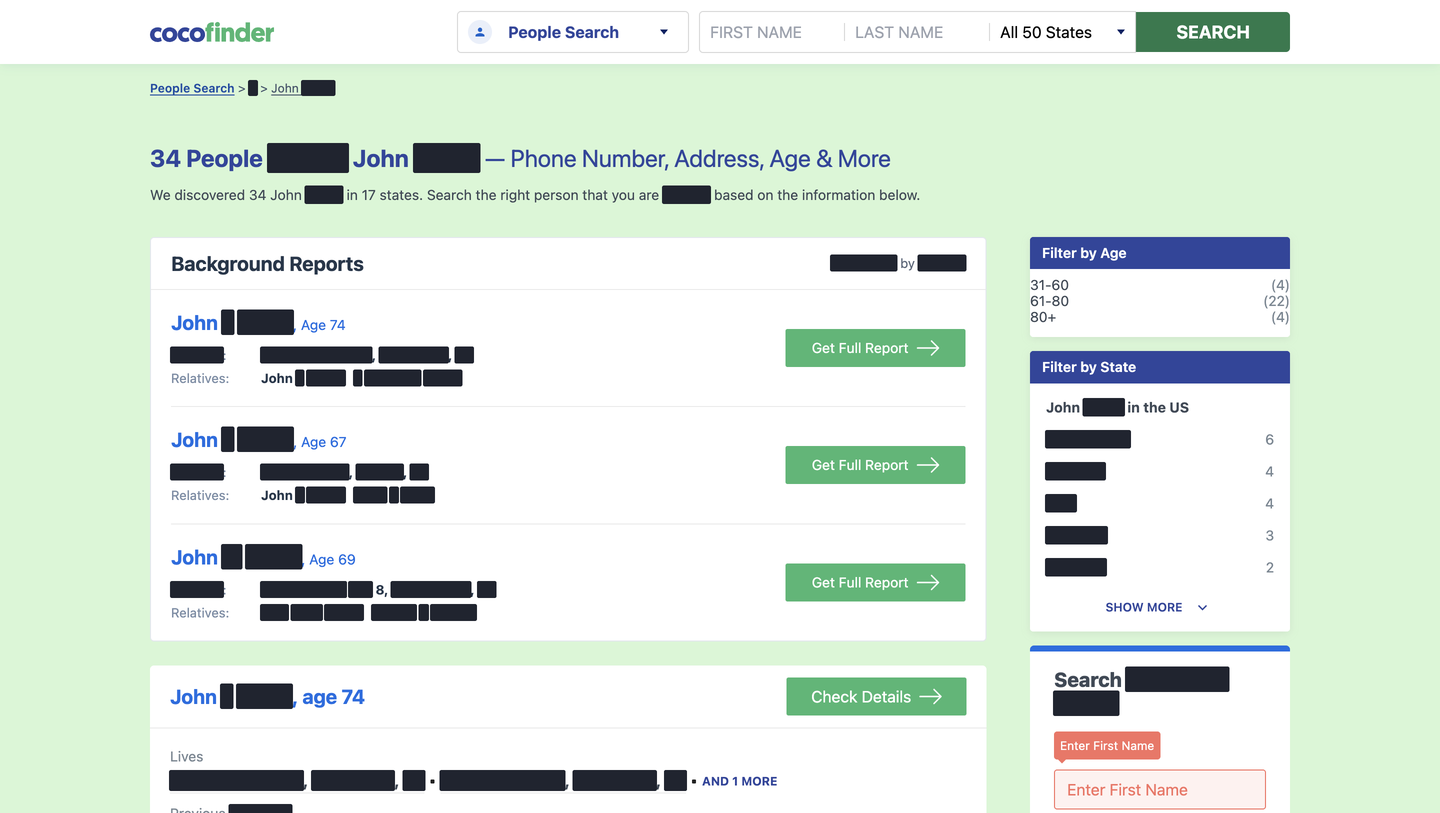
The page above is our own capture with the surnames, addresses and relatives blacked out. We use "John Smith" for these because it's the most common name in the country, which keeps everyone on the page anonymous, but the layout is what you'd see for your own name. A name page opens with a count ("34 People" here, "in 17 states"), then lists each match with a first name, an age, a "Lives" line of current and previous locations, and a relatives row. Filters down the side sort by age band and state.
The homepage FAQ says a full profile "may include the person's full name, age or date of birth, current and previous home addresses, phone numbers, email addresses, known relatives and associates, possible criminal or court records, property records, and aliases or maiden names." On the name pages we captured, the addresses and relatives are visible without paying, and every match carries a green "Get Full Report" or "Check Details" button. Those buttons are the hand-off. Click one and you've left the site for a partner's paywall.
The cocofinder reverse phone lookup works the same way. The FAQ says it returns "the likely owner's name, the carrier, the line type (mobile or landline), and any associated address history." In our experience the preview is thin and the detail is the upsell.
Is CocoFinder legit?
It's a real site with real data, and there's nothing on it you can pay for, so "is cocofinder legit" is really two other questions: is the information accurate, and is the site itself honest about what it's doing.
On the second, more so than most. It says its own search is free, says the deeper reports belong to other companies, and discloses the referral fees. What it doesn't say is that the homepage search box skips its own records entirely; you have to already know about the name pages to see what it holds on you.
On accuracy, treat any listing as a machine's best guess. The homepage says "not every profile contains every field," which is true, and the reverse is also true: fields get filled with the wrong person's data. Records are merged automatically on name, address and phone, and the errors we see across every aggregator show up here too: a former address listed as current, a relative who was a tenant, and split profiles for one person under a nickname and a legal name.
Assembling all of that on one public page is the raw material for doxxing and for the family-emergency phone scams that need a relative's real name to land. The records were public before. The convenience is new.
Is it legal for CocoFinder to publish this?
Yes under federal law, with one boundary the site draws for itself. Its footer states that it "is not a consumer reporting agency per the Fair Credit Reporting Act," and that you "may not use our site or service or the information provided to make decisions about employment, admission, consumer credit, insurance, tenant screening or any other purpose that would require FCRA compliance."
That disclaimer works in the company's favour. Because it's not a consumer reporting agency, the Fair Credit Reporting Act's accuracy rules and dispute rights don't reach it. If a listing about you is wrong, nobody is obliged to investigate. The public records underneath are lawful to republish, and the site's own FAQ notes that "removal from CocoFinder does not remove the underlying public record from its original government source." State broker laws such as California's Delete Act are starting to add obligations, but none currently requires a site to remove you unprompted.
What being listed here means for you
The name pages are built to rank. They're static, indexed, and titled with the person's name, so a search for you can surface one. Anyone who clicks gets your age, your city, your address history and your relatives without logging in.
The site also says searching is anonymous: "We do not notify the person being searched." So you'll never know who has looked. For most people the practical cost is unwanted calls and a nagging exposure. If you have a stalker, a hostile ex or a job that puts your name in public, it's a page worth removing now rather than later.
How to remove yourself from CocoFinder
Removal is free, requires no account, and the site's own FAQ says the average request "is between 24 to 48 hours." The complication is the form.
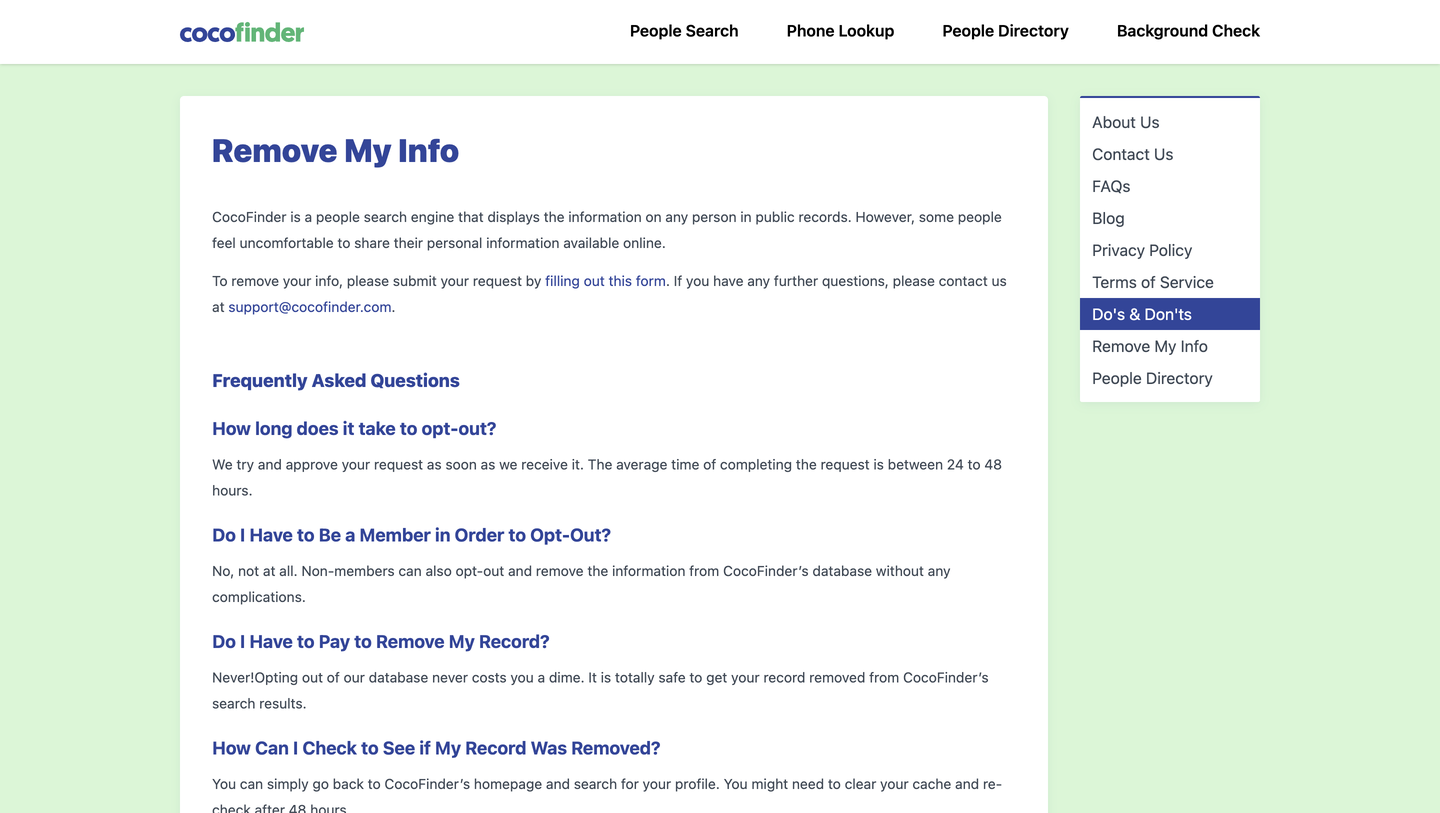
The Remove My Info page, captured above, tells you to "submit your request by filling out this form." That link goes to a Google Form, and Google has taken the form down. Opening it returns an error saying you can't access the item "because it is in violation of our Terms of Service." We first confirmed that on August 26, 2026, and it was still returning the same error when we rechecked on September 6. This is the fastest-decaying fact on this page, so try the form first; the company may have fixed or replaced it by the time you read this.
| Path | Status as of September 6, 2026 | What to do |
|---|---|---|
| Linked Google Form | Down (Terms of Service error) | Try it anyway; if it loads, use it |
| Email to support@cocofinder.com | Working; listed on the removal page and privacy policy | Send your full name as it appears and the exact profile URL |
The email is the path that works. Find your listing on a name page, copy its URL from the address bar, and send both to the support address asking for the record to be removed from search results. If you're filing for a relative, the FAQ says you'll need "an admissible written authorization request from that person." After 48 hours, search the name page again; the site notes "you might need to clear your cache" to see the change. There's no confirmation link to click, so a quiet inbox doesn't mean the request failed.
Our CocoFinder opt-out guide covers each step with captures. For the wider job across every site you've turned up on, see our guide to removing your personal information from the internet.
Common questions
Is cocofinder.com free? Its own search and name pages are free, with no account and no card. The "Get Full Report" buttons lead to paid reports from partner companies. Opting out is free.
Why does the site have my information? It compiled it from government filings, court and property records, voter rolls and phone directories, per its FAQ. You were never asked.
Does a search notify the person? No. The site says searches are anonymous and the subject isn't told.
How long does removal take? The company says 24 to 48 hours on average. In our experience the email path lands within that window, but with no confirmation step you have to check for yourself.
Will my listing come back? It can. A new public record can generate a fresh listing at a different URL that your earlier request never touched. That re-listing cycle is why one removal is never quite the end.
Is coco finder the same as cocofinder.net? Yes. The spaced spelling is just how people type it, and the .net domain redirects to the main site.
A broken form with no confirmation loop is exactly the kind of removal that needs a follow-up nobody remembers to make. Delist My Data is being built to make it, on CocoFinder and the rest, and to re-send the request when the listing reappears. Pre-launch for now; the waitlist is open.