MyLife.com is a people-search site that attaches a "Reputation Score" and a background-report teaser to name listings, and it is the only site we track with a $21 million federal settlement behind that teaser. If you typed "mylife" or "my life.com" into Google after finding a score next to your own name, this page covers what the site is, who owns it, what a listing shows, what the FTC case was about, and how to get your record removed for free, with the field-by-field version in our MyLife opt-out guide.
What is MyLife.com?
"What is mylife" gets asked a lot because the site sits between two businesses. On one side MyLife.com is a standard people-search site: type a name, get a list of matching people with an age, a city and some relatives. On the other, it dresses each result in language borrowed from background-check services. A listing carries a Reputation Score and a teaser suggesting the full report may hold court, arrest or sex-offender records, which you can see if you subscribe.
Who owns MyLife?
The defendants in the federal case described below were MyLife.com, Inc. and its CEO Jeffrey Tinsley. The operator on file today is a different name: California's data broker registry lists mylife.com under Insightbridge LLC, at a suite address in Sheridan, Wyoming, and the site's own footer copyright now reads "InsightBridge LLC," as does the first line of its privacy policy. Neither the site nor the registry explains the relationship between the two companies, and we're not going to guess at it. The same registration reports the company's 2024 request figures: 37,196 requests to opt out of sale received, 36,677 honoured in full and 519 denied, with a median response of two days.
It's not part of PeopleConnect, despite how often the two get lumped together in removal checklists. PeopleConnect's own site names Classmates, Intelius, TruthFinder, US Search and Instant Checkmate, and nothing else. We cover that group in who owns PeopleConnect; the point for you is that removing yourself from Intelius does nothing here.
One practical note. When we checked, the site returned a 403 error to every request that didn't come from a real browser, including the privacy-request page. That is why some automated removal tools report it as unreachable, and why everything below comes from our own browser sessions rather than a scraper.
What a MyLife search shows
Run a mylife search on a name and you get a results list, each entry showing an age, a current city, past cities, and a set of relatives. The profile page for one person adds the parts that make this site different from Whitepages or ThatsThem:
- the Reputation Score, a number the site generates for each person. In our browser sessions we found no explanation on the page of how it is calculated, and you get no say in it
- a background-report teaser, worded so a stranger can't tell whether the "records" it hints at exist; this is the feature the FTC sued over
- relatives and associates, merged by shared addresses, which is how ex-roommates end up listed as family
- age and birth year, in our experience the field most often correct
There is no screenshot of a results page here, and that is deliberate. For every site we profile, our screenshot pipeline captures a real search (we use "John Smith" because it is the most common name in the country), blacks out surnames and details, then runs an automated privacy check before anything is published. This is the one site where that check passed and the image was still wrong, twice. The result names are rendered in a way a DOM text walker can't reach, and the list re-renders after the page loads, so an image verified as redacted still showed uncovered names once the second render landed. We dropped the screenshot rather than risk publishing someone's name. That same script-heavy page is why removal tools struggle with this site.
Is MyLife legit?
The "is mylife legit" question has an unusually direct answer, because a federal court has already looked at it. In July 2020 the Department of Justice, on behalf of the Federal Trade Commission, sued MyLife.com, Inc. and Tinsley. The FTC's press release says the company "deceived consumers with 'teaser background reports' that often falsely claimed to include information about arrest, criminal, and sex offender records," shown to "persuade consumers to sign up for auto-renewing premium subscriptions." The complaint alleged the teasers "led some consumers to believe they or other individuals had arrest or criminal records when they did not, or if they only had minor traffic citations."
The case ended with a stipulated order filed December 16, 2021, listed on the FTC's case page under the heading "FTC, DOJ Obtain Ban on Negative Option Marketing and $21 Million for Consumers Deceived by Background Report Provider MyLife."
On accuracy, the same complaint alleged the company failed "to ensure the information was accurate." Our own observation matches every aggregator: the age is usually right, the relatives are a mix of real family and people who once shared an address, and a common name splits into two or three near-duplicate profiles. The mylife reputation score is the odd one out. It isn't drawn from a record at all; it is a number the site produces, and you can't correct it, only remove the profile it sits on.
Is it legal for MyLife to publish this?
Here the site differs from most of the industry, and the difference matters if a listing has cost you a job or an apartment. The timeline below is from the FTC's case page.
| Date | What happened |
|---|---|
| July 27, 2020 | DOJ files the complaint for the FTC in the Central District of California (case 2:20-cv-06692) |
| December 16, 2021 | Stipulated Order for Permanent Injunction and Equitable Monetary Relief filed; $21 million and a negative-option marketing ban |
Most people-search sites disclaim being a consumer reporting agency, which keeps them outside the Fair Credit Reporting Act and means they owe you no dispute process. The FTC took the opposite view of this company. In the agency's words, "the complaint maintains that MyLife is a consumer reporting agency (CRA), assembling and selling consumer reports," noting the site "has touted in testimonials that its reports were useful to those making housing, lending, and employment eligibility decisions." The FTC alleged it violated the FCRA by "failing to maintain reasonable procedures to verify how its reports would be used, to ensure the information was accurate, and to make sure that the information it sold would be used only for legally permissible purposes."
What that means for you: republishing public records about you stays legal, and the order didn't shut the site down. But if you can show one of its reports was used to deny you housing, credit or employment, you are in far stronger territory than with a site that has always operated as a plain directory. Keep a dated screenshot.
What being listed on MyLife means for you
The harm here is different from a plain address listing. A Whitepages page tells a stranger where you live. A listing here tells them where you live and then puts a score and the word "records" next to your name. To a landlord, a first date or a hiring manager who searched you on their phone, the implication does the work whether or not anything is behind it.
The address, age and relatives data is the same raw material doxxing runs on. The score is a reason to move faster than usual, since it's the one item on the page you can't argue with, only delete.
How to remove yourself from MyLife.com
The removal is a single form at mylife.com/privacyrequest plus an email verification, and it costs nothing. The page itself is almost empty: it's a JotForm embed, titled "Deletion and Opt Out of Sale of Personal Information," on a page marked noindex so it never shows up in search. The form asks for your state, first and last name, street address, city and ZIP code, birth year ("helps us locate your correct profile"), a middle initial, a maiden or alias name, the URL of your profile, your email, and a CAPTCHA. There is no request-type menu; deletion and opt-out of sale are one request. The email field has an inline validator beside it, which you can see in our capture below; that verification is a gate, and unverified requests don't move. The form's small print says a matching profile "will be permanently removed," that the email you give will also be unsubscribed and any account under it deleted, and that the rights it offers belong to residents of the states it lists "and (at our discretion) residents of other states as well."
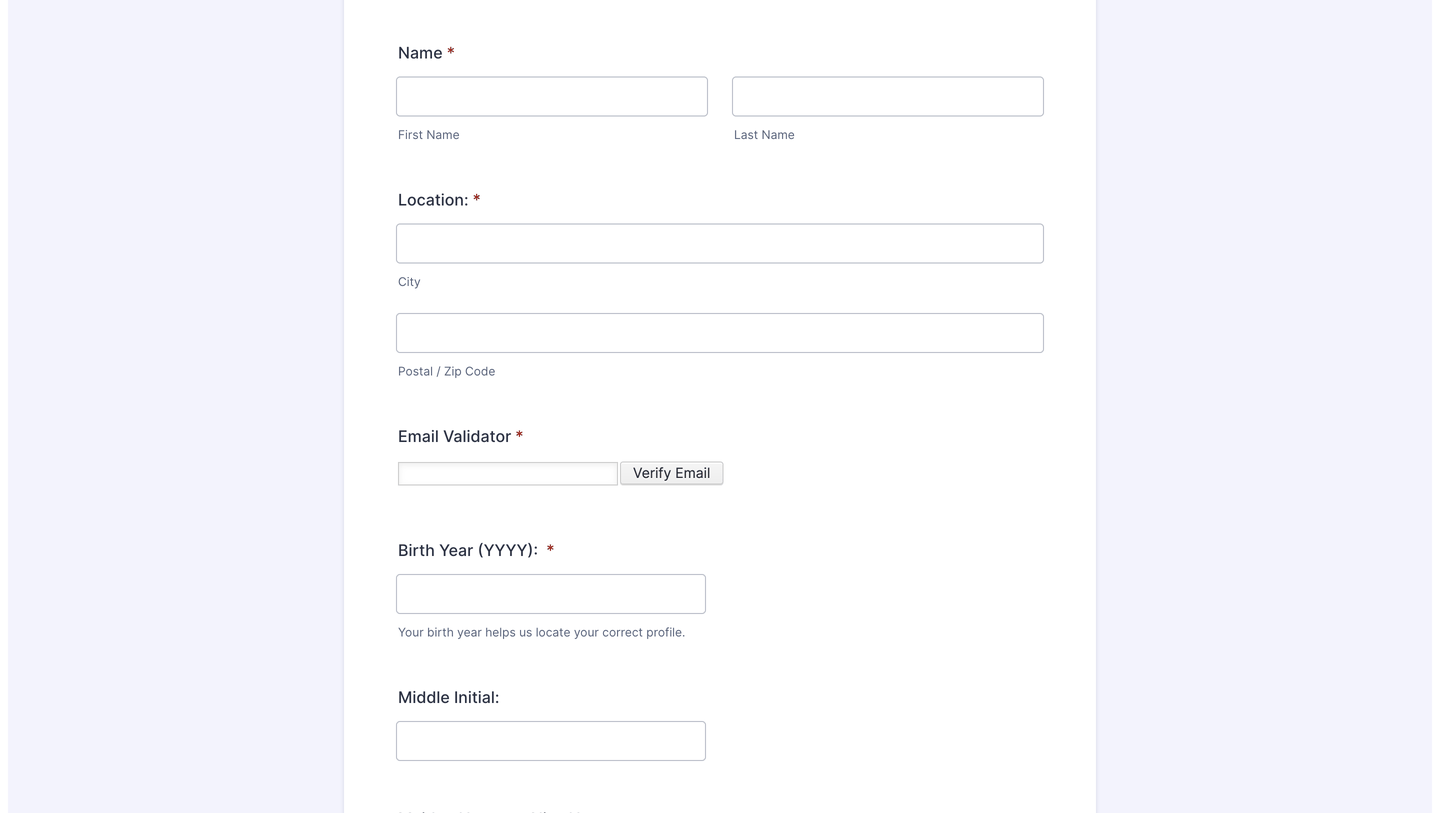
Don't create an account to do this. Claiming your profile hands the site verified details it didn't have, and it isn't required for deletion.
On timing, be careful with what you read elsewhere. The form says only that requests are "processed within the legally required time frames," and the registry filing above puts the company's own median at two days for 2024. In our own removals the profile and its score have taken about one to two weeks to clear; that is observed, not promised. If nothing has changed after three weeks, write to membersupport@mylife.com, the support address on both the form and the registry, with your name and profile URL.
Our step-by-step MyLife opt-out guide walks each field with screenshots, including how to copy the profile URL on a phone. For the other sites holding the same data, see our full removal guide.
Common questions
Is the removal free? Yes. The privacy-request form costs nothing and needs no subscription.
Can I fix my mylife reputation score instead of deleting the profile? Not in any way we have found. The site doesn't publish how the score is built, and the only control it offers you is deletion of the profile the score is attached to.
Why does mylife.com say I might have criminal records? That wording is the teaser the FTC sued over in 2020. The complaint alleged those hints were often false, and the 2021 order banned the negative-option marketing tied to them. The hint's existence says nothing about your record.
Is it owned by PeopleConnect? No. PeopleConnect lists Classmates, Intelius, TruthFinder, US Search and Instant Checkmate as its brands. This site is registered to Insightbridge LLC and has its own removal form.
Why can't my removal tool reach the site? When we checked, it refused every request that didn't come from a real browser, and its pages re-render after loading. Tools that fetch pages the way a script does can't see it. Filing the form yourself in a normal browser works.
Will my listing come back? It can. A new address or a record from a source the site didn't have before can rebuild a profile, score included, with no notice to you. That re-listing pattern is why we suggest searching yourself again every few months.
The site's history is a reason to check back on it more often than most. Delist My Data is built to do that checking, on MyLife and across the people-search sites, and to re-file the privacy request when a profile comes back. We're in pre-launch, with the waitlist open for founding-member access.