411.com is a people-search site owned and run by Whitepages, and the listing you found there is the same record that appears on whitepages.com under a different address bar. That single fact changes how you should think about it. The site's tagline is "Find contact information on yourself or anyone else," and the footer reads "© Whitepages Inc." There is no separate database to worry about and no separate form to fill in. This page covers what a 411.com search shows, whether it's legitimate, and how one Whitepages suppression request takes down both copies, with a link to our 411.com opt-out guide for the click-by-click version.
What is 411.com?
The 411 name comes from the old directory-assistance number, and for years the domain was a phone-book style directory. Today it's a storefront for Whitepages, the Seattle company that has published online white-pages listings since 1997, when, by its own account, it launched as a digital alternative to the printed phone book. The site offers three searches: people search by name, reverse phone lookup, and address lookup through the mobile app.
Three things on the live site confirm the relationship, and we checked each of them ourselves while building the removal guide:
- the footer copyright names Whitepages Inc., not a 411 entity
- the privacy links resolve to Whitepages policy pages
- the record IDs in 411.com profile URLs are the same IDs used on whitepages.com, with a "411-" prefix in front of them
That last one is the useful clue. It means a listing on 411.com isn't a copy that could drift out of sync; it's a second window onto one record.
What a 411.com search shows
Type a name and a state into 411.com and you get a results list. Our capture below is a real one, for the most common name in the country, with the personal details blacked out.
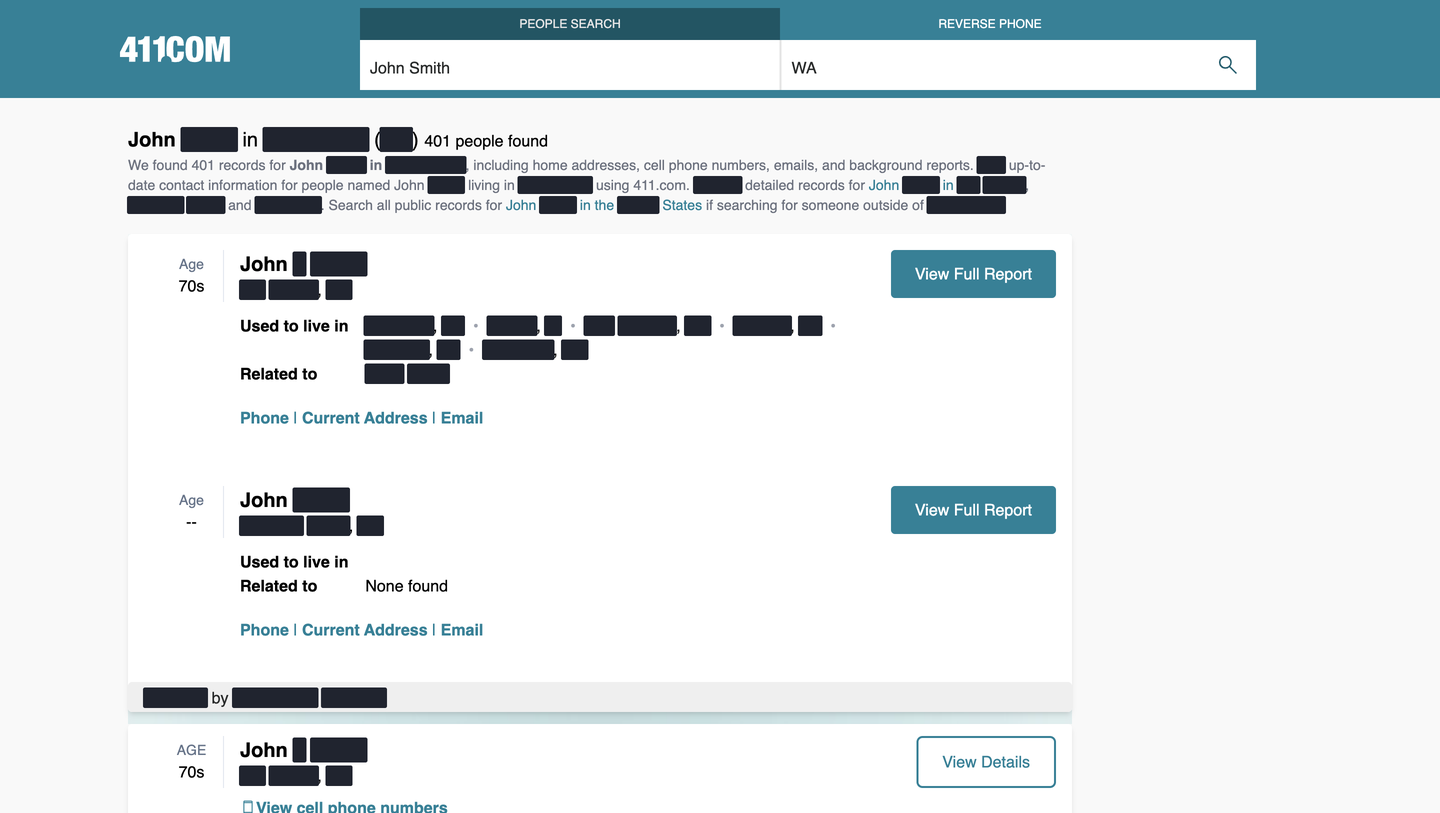
Four hundred and one people for one name in one state. Each card carries an age range, current and past cities, and "possible relatives," and a "View Details" button that opens the full record. We use "John Smith" for these captures precisely because that many namesakes makes any single one anonymous; searching your own name will return a much shorter list, and the card that's you will be obvious from the cities and relatives.
The full record is what Whitepages sells subscriptions to: address history, landline and mobile numbers, email addresses, relatives, and, on the paid tiers, background-check style extras. The free layer is enough to confirm that you're listed and to see your age bracket and where you've lived, which is also enough for a stranger to do the same.
Is 411.com legit?
Yes, in every ordinary sense. Whitepages is a real, long-established company, the searches return real records, and nobody is going to steal your card details by using the site. The "is 411.com legit" question usually comes from two other worries.
The first is whether the site is impersonating the old 411 directory service. It isn't; it's a legitimate brand that Whitepages owns and operates. If anything, the brand's age is why it ranks so well for people's names.
The second is accuracy, and here the answer is the same as for every aggregator. Records are assembled by machine from public records, phone directories and commercial data. Our own removal work turns up the familiar errors constantly: a former roommate listed as a relative, a phone number that now belongs to someone else, and the same person split across two records because one source had a middle initial and another didn't. Treat what you see as a lead, not a fact.
Is it legal for 411.com to publish this?
Publishing public-record and directory data is legal in the United States. Whitepages' terms of service state that it "is not a consumer reporting agency for purposes of the Fair Credit Reporting Act" and that its information may not be used for decisions covered by the Fair Credit Reporting Act: hiring, tenant screening, credit, insurance. That keeps the company outside the consumer reporting agency rules and leaves you without the dispute rights an FCRA-covered report would carry.
Whitepages is a registered data broker in California, and its 2026 filing in the state registry reports its 2024 numbers: 34,722 opt-out requests received, 33,747 granted and 975 denied, plus 5,879 deletion requests with 5,697 granted. A 97 percent grant rate is about as good as this industry gets; FamilyTreeNow, in the same registry, refused one request in four.
Whitepages also puts a timeline in writing, which few sites do. Its consumer-rights page says opt-out requests "may take up to 15 days to process but are often processed more quickly when feasible," and its help-center article on removing a listing warns that search engines can keep showing cached copies for "up to 30 days in some cases." That's slower than the three-day figures smaller sites quote, but it's a published figure rather than an estimate.
What being listed on 411.com means for you
Because the record is shared, appearing on 411.com means appearing on whitepages.com and on Whitepages' other surfaces too. A stranger who finds you on one has found you on all of them. The free layer already gives away your age bracket, your city history and your relatives' first names, which is the raw material for the "family emergency" phone scams and for doxxing.
The flip side is that the shared record also makes this one of the more efficient removals you'll do. One request, two sites down, and Whitepages states that suppressing a record removes all known connected listings.
How to remove yourself from 411.com
There is no opt-out form on 411.com itself, and you don't need one. The route is:
- Confirm the listing on 411.com so you know which record is yours.
- Find the same record on whitepages.com and copy its URL from the address bar.
- Paste it into the form at whitepages.com/suppression-requests and pick any reason.
- Take the automated verification phone call and enter the code.
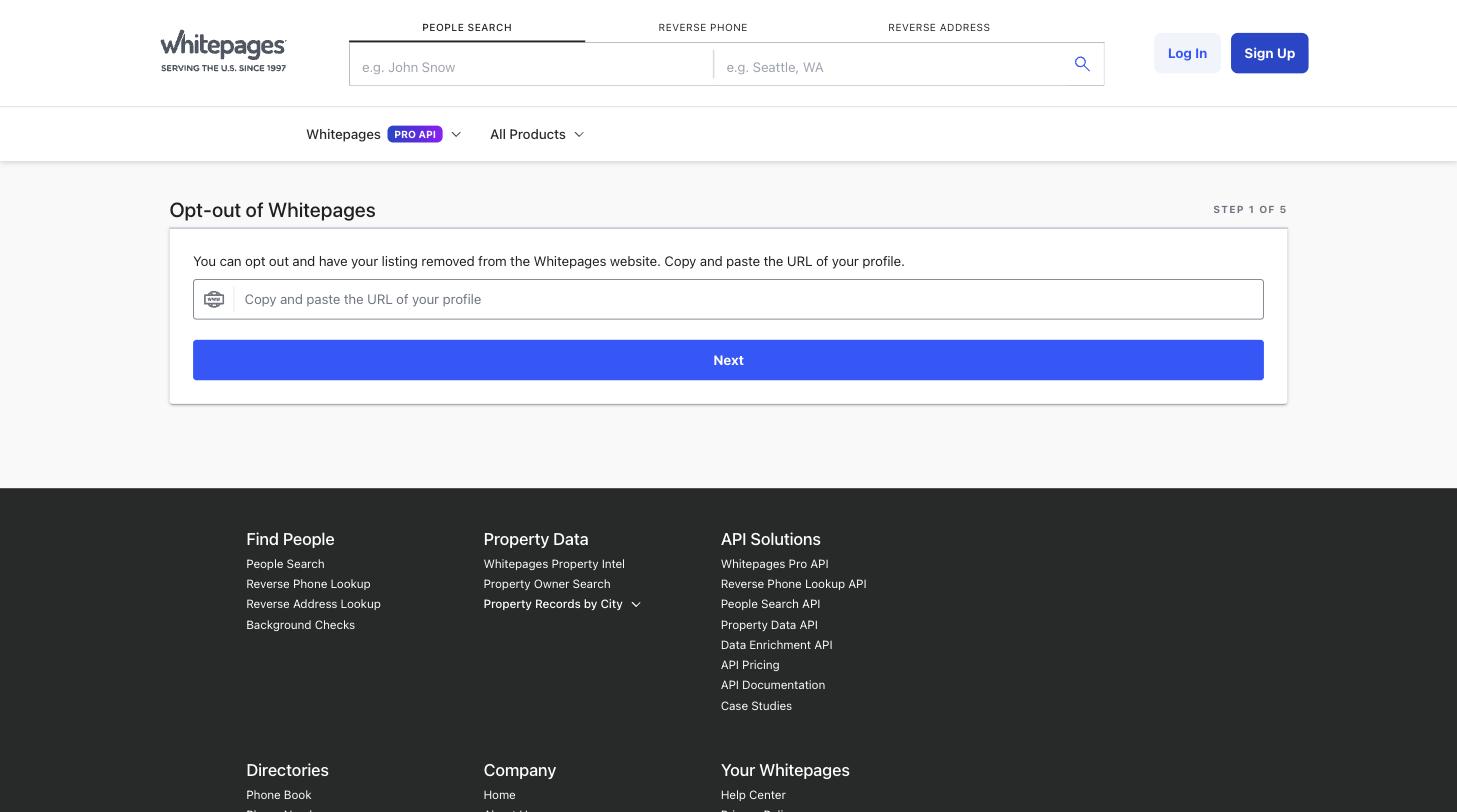
The phone call is the step people dislike. Whitepages says the number "will not be used for any purpose other than completing your opt-out request," and the alternative for anyone who won't hand over a number is a written request through the online privacy form or to privacyrequest@whitepages.com, which skips the call; the page asks for up to two business days for a reply to the form. Our 411.com opt-out guide walks each screen, and the Whitepages guide covers the same form in more depth.
One correction from our own library: an earlier version of our guides said Whitepages clears requests in 72 hours. Whitepages doesn't publish that figure anywhere we can find. The 15-day window above is what its consumer-rights page actually says, and most requests we've watched clear well inside it.
Common questions
Is 411.com the same as Whitepages? Same company, same records. The domain is a Whitepages brand.
Is 411 com free? Searching and seeing the summary card is free. Full reports require a Whitepages subscription. Removal is free.
Does 411.com have a reverse lookup? Yes, for phone numbers, and the result comes from the same Whitepages record as the name search.
Do I need to opt out of 411.com and Whitepages separately? No. One suppression request through Whitepages covers both, because it's one record.
How long does removal take? Whitepages says up to 15 days; in our experience most clear sooner. Give search engines up to 30 more days to drop cached copies.
Will I come back? You can. Suppression hides the record; it doesn't stop Whitepages ingesting a new address or phone number later and building a fresh one, the re-listing cycle that affects every broker.
Because 411.com rises and falls with the Whitepages record behind it, the thing to watch is Whitepages. Delist My Data is being built to do that watching, on this record and across the other people-search sites, and to file again when a new listing appears. We're in pre-launch; the waitlist is open for founding-member access.