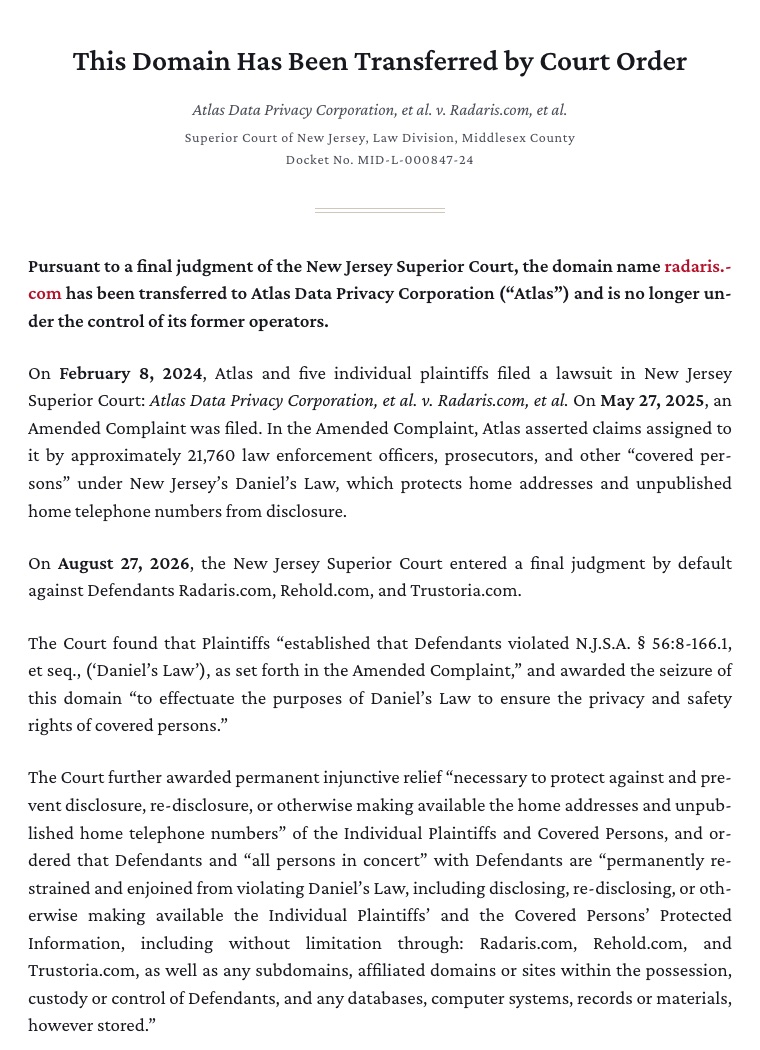
If you type radaris.com into a browser today you get a court notice, not a people-search site. On August 27, 2026, the Superior Court of New Jersey entered a final default judgment against Radaris.com, Rehold.com and Trustoria.com for violating Daniel's Law, and ordered the radaris.com domain handed to the plaintiff, Atlas Data Privacy Corporation. Atlas now controls the address and uses it to publish the judgment.
It is one of the most direct enforcement actions ever taken against a people-search broker. It is also narrower than the headlines suggest. The court protected a defined group of New Jersey officials, the data was not ordered destroyed for everyone else, sister sites run by the same people are still online, and Radaris's lawyer says the judgment is void. Here is what the primary record shows.
The case: Atlas Data Privacy Corp. v. Radaris.com
The case is Atlas Data Privacy Corporation, et al. v. Radaris.com, et al., Superior Court of New Jersey, Law Division, Middlesex County, Docket No. MID-L-000847-24. The dates below come from the notice now posted at radaris.com, which Atlas controls. That makes it the plaintiff's account of its own case, but the docket number and quoted order language are checkable against the court's records.
| Date | Event |
|---|---|
| November 2020 | Daniel's Law enacted, after the son of U.S. District Judge Esther Salas was killed at the family's home |
| February 8, 2024 | Atlas and five individual plaintiffs sue Radaris.com and related defendants in Middlesex County |
| May 27, 2025 | Amended complaint filed, asserting claims assigned by about 21,760 law enforcement officers, prosecutors and other covered persons |
| August 12, 2026 | New Jersey Supreme Court holds that Daniel's Law needs no proof of fault for actual damages (a separate case) |
| August 27, 2026 | Final judgment by default against Radaris.com, Rehold.com and Trustoria.com; radaris.com transferred to Atlas |
| September 16, 2026 | KrebsOnSecurity reports 14 Radaris-family domains transferred so far |
Daniel's Law, codified at N.J.S.A. 56:8-166.1, lets a covered person (such as a judge or police officer, or a family member living with one) send a notice asking a business to stop disclosing their home address or unpublished home phone number. The business has 10 business days to comply. If it doesn't, the statute awards actual damages or liquidated damages of $1,000 per violation, plus punitive damages for willful or reckless disregard. Atlas runs the service many covered persons use to send those notices, and takes assignments of their claims.
What the Radaris judgment actually orders
According to the notice, the court found that the plaintiffs "established that Defendants violated N.J.S.A. § 56:8-166.1, et seq., ('Daniel's Law'), as set forth in the Amended Complaint," and awarded the domain "to effectuate the purposes of Daniel's Law to ensure the privacy and safety rights of covered persons."
The injunction is the part with the longest reach. Defendants and "all persons in concert" with them are "permanently restrained and enjoined from violating Daniel's Law, including disclosing, re-disclosing, or otherwise making available the Individual Plaintiffs' and the Covered Persons' Protected Information, including without limitation through: Radaris.com, Rehold.com, and Trustoria.com, as well as any subdomains, affiliated domains or sites within the possession, custody or control of Defendants, and any databases, computer systems, records or materials, however stored."
Two limits are written into that sentence. It protects the individual plaintiffs and the covered persons in the case, not the public at large. And it forbids disclosure of their protected information, meaning home addresses and unpublished home phone numbers. It does not order Radaris to delete its database, and nothing in the quoted language speaks to anyone outside the case.
A default judgment also means the defendants did not defend the case on the merits. No court has weighed evidence from Radaris's side, which matters for what comes next.
Which Radaris sites went dark
Atlas and Krebs both say 14 domains have been transferred, but neither has published the list. So we checked ourselves. On September 26, 2026 we requested the home page of every domain KrebsOnSecurity tied to the Radaris network in its 2024 investigation, plus Veripages, whose revenue appears in the same Atlas evidence Krebs described in 2026.
| Domain | What it served on September 26, 2026 |
|---|---|
| radaris.com | Court-order transfer notice |
| rehold.com | Court-order transfer notice |
| trustoria.com | Court-order transfer notice |
| centeda.com | Court-order transfer notice |
| clubset.com | Court-order transfer notice |
| newenglandfacts.com | Court-order transfer notice |
| pub360.com | Court-order transfer notice |
| difive.com | Court-order transfer notice |
| comfibook.com | Court-order transfer notice |
| veripages.com | Live, behind a Cloudflare check |
| bizstanding.com | Live, behind a Cloudflare check |
| homeflock.com | Live, behind a Cloudflare check |
| radaris.de | Error (HTTP 503) |
That accounts for 9 of the 14. The other five are somewhere we didn't look. Whois records for radaris.com, rehold.com and trustoria.com all show updates on September 4 and September 10, 2026, which fits a registrar-level transfer after the judgment.
The more important number is the other one. Krebs reports that Atlas's evidence ties radaris.com to "at least twenty-five other people-search websites" run as "one operation" by a small Boston-area group, and most of them are not part of the domain transfer. A court notice at radaris.com means one storefront is closed. It does not mean the records behind it are gone.
Could the seizure be reversed?
It has happened before. On June 19, 2017, the federal court for the Northern District of California entered a $7.5 million default judgment in Huebner v. Radaris, LLC, No. 3:14-cv-04735, a Fair Credit Reporting Act class action Radaris never contested. When the plaintiffs couldn't collect, the court ordered Verisign, the .com registry, to transfer radaris.com to them. According to a history of that episode, the domain went back in May 2018 after Radaris argued that its true owner, a Cyprus company, had never been named in the suit.
Radaris's lawyers are trying the same argument this time. Its counsel, Victor Worms, told KrebsOnSecurity: "We have made a motion to vacate that default judgment on the grounds that it is void since a non-entity has no legal capacity to sue or be sued." A domain name, the argument goes, is not a company. Atlas's CEO, Matt Adkisson, called the run of offshore ownership changes before the default "their island-hopping phase."
Until that motion is decided, treat the seizure as real but not final.
Where Daniel's Law itself stands
The law behind the judgment is still being tested. Atlas has brought dozens of Daniel's Law suits against data brokers, and the defendants in the federal cases argue the statute is unconstitutional. A federal district court upheld it in 2024, and the defendants appealed to the Third Circuit as Atlas Data Privacy Corp. v. We Inform, LLC, No. 25-1555.
The Third Circuit asked the New Jersey Supreme Court what level of fault the law requires. On August 12, 2026, in a unanimous opinion by Justice Pierre-Louis, the state court answered that "Daniel's Law does not contain a mental state requirement for actual damages liability." In plain terms, a broker that misses the 10-business-day deadline is liable for actual damages whether or not it meant to. The opinion says the constitutional question is for the Third Circuit, which has not yet ruled.
So the Radaris judgment rests on a statute that New Jersey's top court has read strictly and a federal appeals court has not yet finished reviewing. We covered the rest of New Jersey's broker rules, including the newer A.5328 registry law, in our New Jersey data broker law explainer.
What this means if Radaris listed you
If you are a Daniel's Law covered person in New Jersey, the injunction is written for you. It bars disclosure of your protected information through any affiliated site the defendants control. If you find your home address on a Radaris-family site, that is the evidence Atlas or your own lawyer would need, and the state's Daniel's Law portal explains how covered persons send notices.
If you are anyone else, the judgment doesn't change your rights. It does change your to-do list:
- You can't use Radaris's own opt-out form any more, because the site behind it is gone. Our Radaris opt-out guide now carries a notice to that effect.
- The records Radaris compiled were not ordered destroyed. Search for yourself on the network's surviving sites, starting with Veripages, and on the large people-search brokers that buy from the same public-record sources.
- If Radaris wins its motion to vacate, the domain could come back with your old profile on it. Recheck radaris.com in a few months rather than assuming it's gone for good.
Radaris was never on California's data broker registry, so a California DROP request never reached it. It took a New Jersey lawsuit brought on behalf of police officers to close the front door. For most people, the direct opt-out is still the only tool that works against the rest of the network.
Frequently asked questions
Is Radaris shut down?
The radaris.com website is. Since the August 27, 2026 judgment it has served Atlas Data Privacy Corp.'s court notice instead of people-search results. The business is not necessarily shut down: KrebsOnSecurity reports at least 25 related sites still operating, and Veripages was live when we checked on September 26, 2026.
Who owns radaris.com now?
Atlas Data Privacy Corporation, the New Jersey company that brought the lawsuit. The domain was transferred to it by the court's final judgment in Docket No. MID-L-000847-24.
Was my Radaris data deleted?
Not by this order. The quoted judgment forbids disclosing the protected information of the covered persons in the case, and says nothing about deleting records for anyone else. Assume the data still exists and may surface on a sister site.
Why did Radaris lose its domain instead of just paying a fine?
The defendants did not defend the case, and the court entered judgment by default. Handing over the domain is a remedy that works even when the people behind a site can't be found or made to pay. Radaris has moved its operating companies between offshore jurisdictions for years, which is the problem Atlas says the remedy was meant to get around.
Can Radaris get the domain back?
Possibly. Its lawyer has moved to vacate the judgment, arguing that a domain name can't be sued. A similar argument worked once: radaris.com was taken away under a 2017 California federal judgment and returned in 2018.
Delist My Data is being built for exactly this kind of gap: a broker vanishes from one address and its records turn up on another, and someone has to keep checking. We're in pre-launch; join the waitlist for founding-member access.
Sources
- Atlas Data Privacy Corp.: Court-order transfer notice at radaris.com (Docket No. MID-L-000847-24), viewed September 26, 2026
- Supreme Court of New Jersey: Atlas Data Privacy Corp. v. We Inform, LLC (A-8-25), decided August 12, 2026
- State of New Jersey: Daniel's Law FAQs
- CourtListener: Huebner v. Radaris, LLC, No. 3:14-cv-04735 (N.D. Cal.), docket
- FIRE: Atlas Data Privacy Corp. v. We Inform, LLC, No. 25-1555 (3d Cir.), case page
- KrebsOnSecurity: Data Broker Radaris Loses Domains in Privacy Fight (September 16, 2026)
- KrebsOnSecurity: A Close Up Look at the Consumer Data Broker Radaris (March 8, 2024)
- New Jersey Globe: N.J. Supreme Court says Daniel's Law imposes liability without proof of fault (August 12, 2026)
- Sully's Blog: A court just took radaris.com away from its owner, again