Nuwber is a US people-search site that sells contact and background reports on adults, built from government records, and it lets anyone who lands on a listing remove it for free. People usually search "nuwber" for one of two reasons: they saw their own name, age and home town on a nuwber.com page, or they're wondering whether to pay it for a report on someone else. This page covers both. It explains what the site is, who owns it, what a search actually shows, whether it's legitimate, and how to get a listing taken down, using what we saw when we ran it through our own capture and testing work; the click-by-click version is our Nuwber opt-out guide.
What is Nuwber?
Nuwber.com is a people-search site operated by Nuwber, Inc., the name on the copyright line in its footer. Under the search box the homepage promises a "100% Confidential Search" and says "We run over 2 million searches every month," and further down it sizes the database at 301 million people, 118 million addresses, 340 million phone numbers and 442 million social profiles. The list of things it says you can find runs from names and phone numbers through property history to "Criminal records," "Judgments," "Liens" and "Bankruptcies."
Who owns Nuwber?
The company is as plain as its name. Nuwber Inc is registered in California's data broker registry at 700 North Fairfax Street, Suite 614, Alexandria, Virginia, the same address the site prints in its footer, with support@nuwber.com as the contact. It has no sister brands on file and no white-label storefronts that we know of, which makes it unusual in this industry. One oddity in that filing: for 2024 the company reported receiving zero requests of every kind, deletion and opt-out included, even though the removal form below works and we have used it. Whatever it counts, it isn't counting those.
The site's own small print is the clearest statement of where the data comes from. Its reports, it says, "contain information obtained from federal, state, and local government agencies," and the same paragraph concedes the information "may not always be 100% accurate, complete, or up to date." It doesn't itemise sources beyond that. A separate line insists the site "is not affiliated with the United States government or any Federal or State government agency," which tells you how often visitors mistake it for an official records portal.
There's a Log In button in the top corner, and that's the business model in one word. Searching is free. The full report is a product you pay for, which puts it in the same camp as TruthFinder and BeenVerified rather than the ad-supported free sites.
What a Nuwber search shows
The search form has four tabs: Person, Phone, Address and Email. The Person tab takes a full name and a city and state, and that's the search most people mean by "nuwber lookup" or "nuwber people search." The other three are reverse lookups that start from a number, a street address or an email and try to attach a name to it.
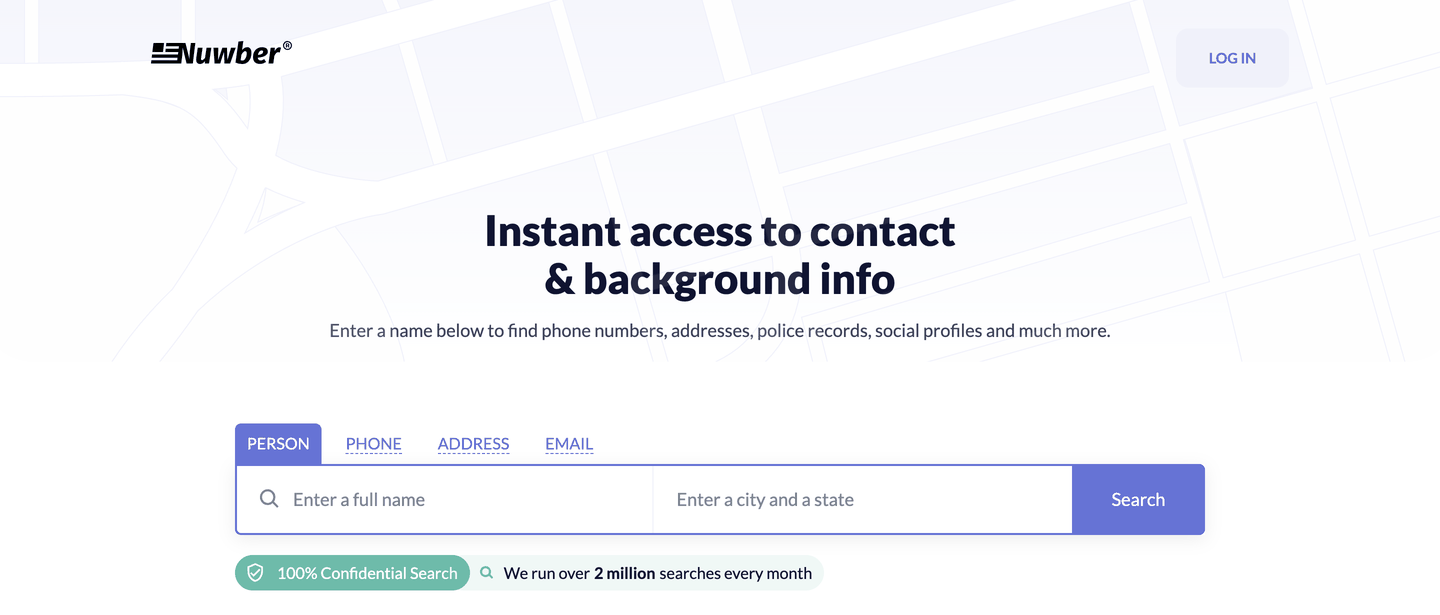
That screenshot is our own capture of the homepage, taken during the walkthrough for our opt-out guide. Before the site will show you results it presents a terms-of-service gate that you have to click through, agreeing you won't use the data for any purpose the Fair Credit Reporting Act regulates. Once past it, a results page lists possible matches by name, age and location, and each opens onto a profile page whose address is nuwber.com/person/ followed by a long hexadecimal string. That string, the profile's unique ID, is what the removal form later asks for.
What's on the profile is the standard people-search bundle: name and aliases, age, current and previous cities, a relatives and associates block, and the phone numbers, addresses, "police records" and "social profiles" the homepage promises, with the fuller version of each behind the paid report.
One finding from our testing deserves more weight than the marketing does. The site gets far more Google searches than most in this category, and you'd expect coverage to match the 301 million people it advertises. When we ran a test identity through its consumer search, a person who appears on more than a dozen other people-search sites at the right age and city, it came back with "0 people." That held both with the state filter set and nationwide. Its coverage is narrower than its search-volume popularity suggests. If you can't find yourself on it, that may simply be true; recheck in a few months anyway.
Is Nuwber legit?
Yes, in the sense that matters for the "is nuwber legit" question. It's a real company with a real database, its opt-out works, and it's not a card-skimming scam. It is a subscription business, so read the billing terms before you pay for a report; recurring charges are the most common complaint about every site in this category.
Accuracy is a separate question, and the site answers it for you in its disclaimer: no warranty, may not be complete or current. In practice that means the same failure modes we see across every aggregator, because the records are merged by software matching names, addresses and phone numbers. You might find an address you left years ago shown as current, a cell number that belonged to whoever had it before you, a "relative" who was a roommate, or two half-profiles for yourself under a middle initial and a maiden name. None of that stops a stranger treating the page as fact.
Is it legal for Nuwber to publish this?
Under current federal law, yes, and the site is careful to stay on the right side of the one statute that could bite. Its footer states that it "is not a consumer reporting agency as defined by the Fair Credit Reporting Act (FCRA) and we do not provide consumer reports," and that the site "shall not be used to make credit decisions, credit granting or denial, credit monitoring, account reviews, insurance underwriting, employment or housing decisions, tenant screening, or for any purpose protected under the FCRA."
Read that disclaimer as protection for the company rather than for you. Because it's not a consumer reporting agency, the accuracy and dispute obligations of the Fair Credit Reporting Act don't apply. If your listing is wrong, you have no legal right to have it investigated. Your only lever is the opt-out. State law is slowly changing this. California's Delete Act and its DROP deletion platform, along with broker-registration laws in Texas, Oregon and Vermont, put duties on data brokers that didn't exist five years ago, but none of them yet makes a site delete you without being asked.
What being listed on Nuwber means for you
The profile page is indexed by Google, so it can appear when someone searches your name, sometimes above pages you actually control. That's the first practical consequence: a stranger, a new employer's curious colleague or a landlord's assistant sees your age, your town and your relatives' names before they see anything you chose to publish.
The second is that a single page assembling age, addresses, phone numbers and family names is the standard starting kit for doxxing, and for the phone scams that need a relative's name to sound convincing. For most people the risk is nuisance calls and a sense of exposure. For anyone dealing with a stalker, an abusive ex, or a public-facing job, it's worth removing today.
The third is quieter. Being absent from this site right now, as our test identity was, isn't a guarantee. Sites in this category restock from fresh public records, and a new address or phone number can produce a new profile later. Absence is a snapshot.
How to remove yourself from Nuwber
The opt-out is free, needs no account, and turns on one detail people get wrong: it identifies your listing by its exact profile URL rather than by your name.
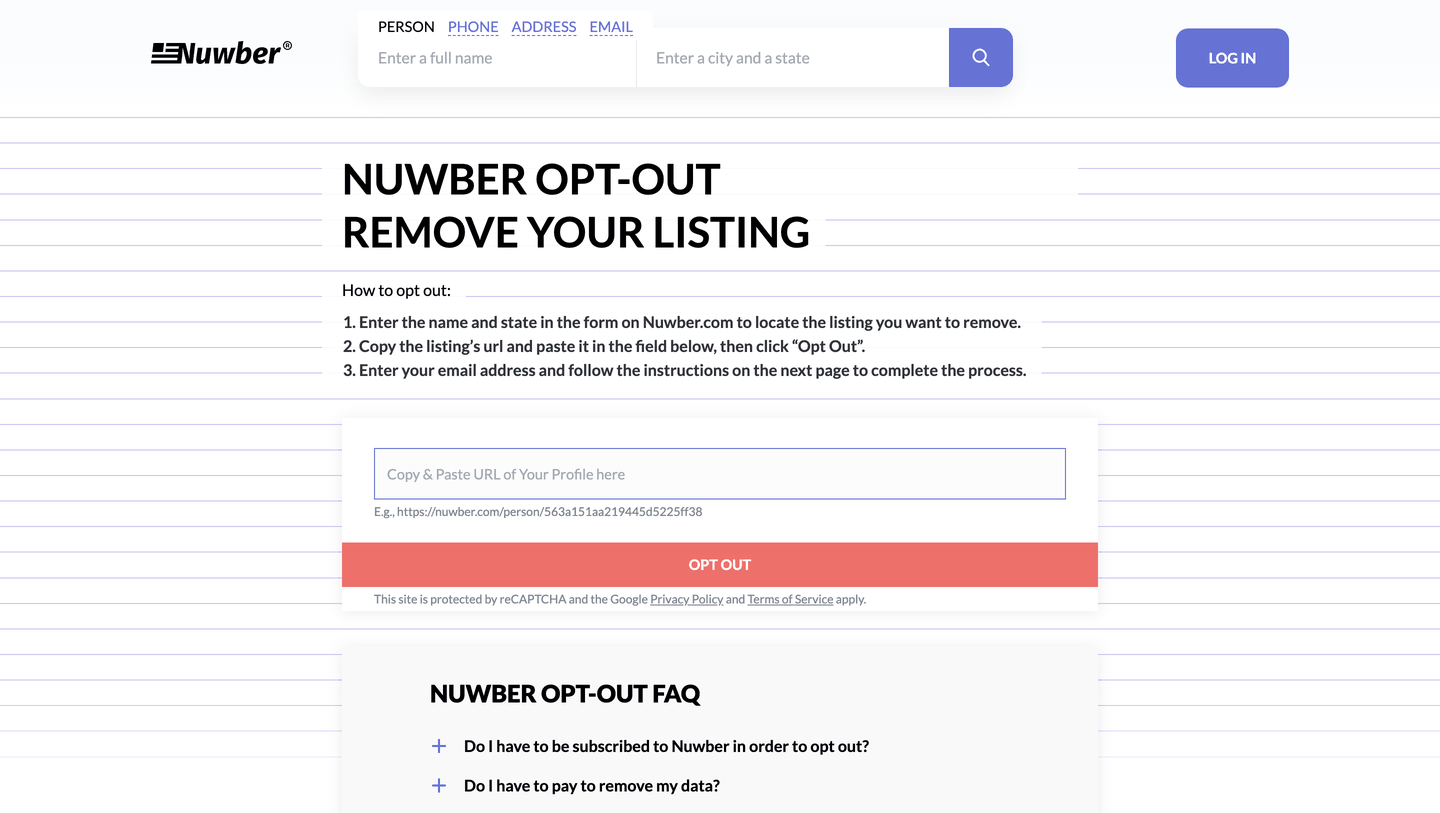
The page above, again our own capture, spells out its own three steps: find the listing on the site, copy the listing's URL and paste it into the field, then enter your email and follow the instructions. Expanded, the flow we walked looks like this:
- Search your name and state, open the profile that's yours, and check the age and relatives so you're not removing a namesake.
- Copy the full URL from your browser's address bar.
- Go to nuwber.com/removal/link, paste the URL, and click Opt Out.
- Enter an email address and click Remove. Use a real inbox: disposable and throwaway email domains get blocked, and a blocked address stalls the request without telling you why.
- Open the email from the site and click "Confirm Request." Nothing happens until you do.
On timing, the site's own opt-out FAQ says the listing "will be deleted soon after you receive our email with a removal link" and that "the removal process may take up to 48 hours." It also gives a check that no other site we cover offers: paste your old profile URL back into the browser, and if the page returns a 410 response code the record is gone. In our experience, allow a couple of days and then search yourself again. If you have listings under more than one name variant, each has its own URL and needs its own request; the FAQ says as much.
Our Nuwber opt-out guide walks each screen with captures. If this is one of several sites you've found yourself on, our guide to removing your personal information from the internet covers the rest of the field.
Common questions
Is nuwber.com free? Searching and seeing the preview are free. The full report is paid and tied to an account. Opting out is free and doesn't require an account.
Why does Nuwber have my information? It bought or collected it from government record sources and commercial data feeds. You didn't sign up, and it never asked you.
Does a Nuwber search notify the person? The homepage advertises "100% Confidential Search," and we've seen nothing in the flow that alerts the person being looked up.
How long does Nuwber removal take? The site's FAQ says up to 48 hours after you click the emailed link. Give it a couple of days, then recheck.
Will my listing come back? It can. A fresh public record with a new address or phone can generate a new profile with a new URL, which your earlier request doesn't cover. That re-listing pattern is why we recommend rechecking every few months.
Does removing my listing delete the underlying records? No. Removal takes the page off the site; the court, property and voter records it was built from stay where they were, and other people-search sites keep their own copies.
Nuwber is one form among dozens, and the forms don't stay done. Delist My Data is designed to keep the list for you and re-file on this site and the others when your record comes back. We're in pre-launch now, and founding-member access goes to the waitlist first.